


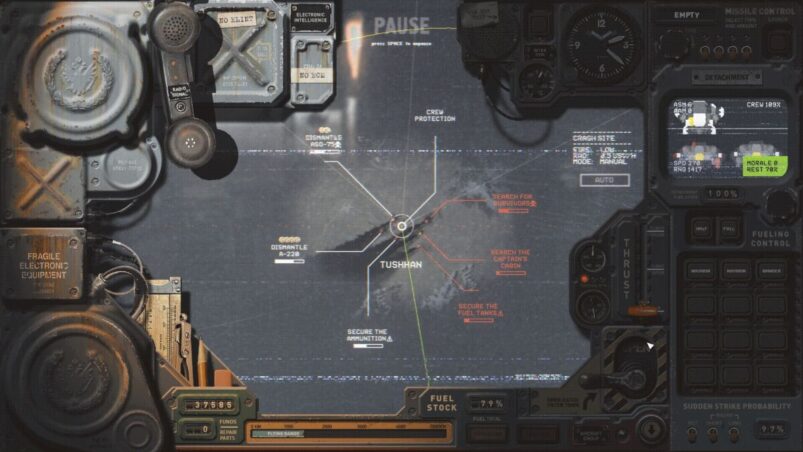
The land of Gerat in the world of HighFleet is full of hostiles and roving threats. As the admiral of an expeditionary force, it’s vital to understand the map and how to find the enemy. There are a number of ways players can improve their situational awareness and navigate the harsh deserts.
Here are the main ways to gather intelligence in HighFleet:
– Visual
– Radio Interception
– Radar
– Radar Interception
– Infrared
– Intelligence Outposts
– Random Events
– Support
– Salvage
And here’s everything you need to know about intelligence and situational awareness in HighFleet.
Visual
Regardless of what ships are in a Strike Group, every single craft will have the good old-fashioned way of spotting targets available to them. Visual spotting is the least efficient method of spotting due to its incredibly short range of detection, which will give minimal time for the player to respond to threats. However, depending on the status of other detection modes or other extenuating circumstances, visual detection is a good last resort.
Radio Interception
Radio interception is just as ubiquitous as direct visual spotting as any ship can use it, but it has its own significant limitations. This type of signal interception allows admirals to play a timed minigame to identify the radio frequency and direction of the signal and, if successful, obtain a message with a report on enemy fleet movement (transport fleets or strike groups). Aside from the timed minigame, the other limitations of radio interception are that players have to have a ship strike group physically selected that is somewhat near enemy movements (can be beyond radar detection) for a chance at interception and that after a while enemies will start encoding messages, requiring players to find a decryption key.
Radar
The most reliable detection and recon method in HighFleet is the trusty radar system, which not all ships have access to. Radar provides a constant zone of detection in a 360 degree angle around a Strike Group and also has the option of being turned off for greater stealth, or narrowed for a more focused angle of detection. This method is the simplest to operate and is best for short to medium range reconnaissance, but enemy fleets equipped with ELINT or radar interception systems can track the player’s movements if their radar is active.
Radar Interception
In some ways radar interception (ELINT) is similar to radio signal interception, however admirals don’t need to play a minigame in order to use it. ELINT detects enemy radar and will provide a constant warning signal for the selected Strike Group (if it has ELINT) with an approximate direction and distance of enemy radar signals. ELINT is always active and won’t give away the player’s position and also has the advantage of generally having longer ranges than radar detection systems, giving players more time to react.
Infrared
Probably the most limited, but no less useful mode of detection is Infrared or IRST. IRST works similarly to a focused radar in that players have to manually angle the system towards an area of interest. However, the main limitations of IRST detection are that it’s usually quite short range (though longer range than direct visual) and it gives only a rough picture or outline of whatever it has detected, whereas radar always gives a clear understanding of enemy ship movement. On the flipside, IRST is completely undetectable and is perfect for stealthy spotting.
Outposts
Throughout Gerat, there are a multitude of enemy held cities, towns, and settlements that have different specialties, one of which is the intelligence outpost. The outposts give players the option to detect the last known position of a random enemy Strike Group, an aircraft or ballistic missile carrier, or of a transport fleet. The range on the outpost is unlimited, but it has a limited amount of points to spend and the outpost will only benefit the player if they clear the enemy garrison first and land their fleet there.
Random Events
Occasionally, when the player fleets land in a settlement, they’ll be greeted with a random event, which could range from a meeting with a village elder to an encounter with a passing caravan. Some of these events can give valuable information on a wide variety of things, such as a report on a nearby potential ally, a hidden city, or an enemy transport fleet. These events are pretty sparse and quite limited and shouldn’t be relied on as a primary source of reconnaissance, but they have their situational uses nonetheless.
Support
As players gather allies throughout their arduous journey, they will be able to call on them for a variety of support actions, such as increasing repair speed, improving morale, or getting some extra cash. Some allies will even offer support in intelligence gathering by using their network of spies, moles, and connections. This type of support action is equivalent to using an intelligence outpost with a slightly reduced effect, as in a dedicated intelligence outpost will give more information than an ally.
Salvage
Another option for intelligence is rummaging through the wrecks of enemy ships after a successful battle. Sometimes an enemy Captain’s cabin will still be intact enough for players to search for valuable intelligence reports. However, the only information admirals will get from this type of intelligence gathering method is a report on potential recruitable allies and minor enemy fleet movements. In essence, this is only slightly better than random events, but shouldn’t be relied upon as the main source of information.
Highfleet really does make players feel like commanders of fleets from combat and all the way up to dealing with the unknown and imperfect information. Admirals have to wade through uncertainty with a variety of limited methods of gathering information and make the best use of it. Now that players know the main ways to improve their own situational awareness, the real challenge of reaching the enemy capital begins.
HighFleet is available for PC.
READ NEXT: The Best World War 2 Strategy Games of All Time
Some of the coverage you find on Cultured Vultures contains affiliate links, which provide us with small commissions based on purchases made from visiting our site.