


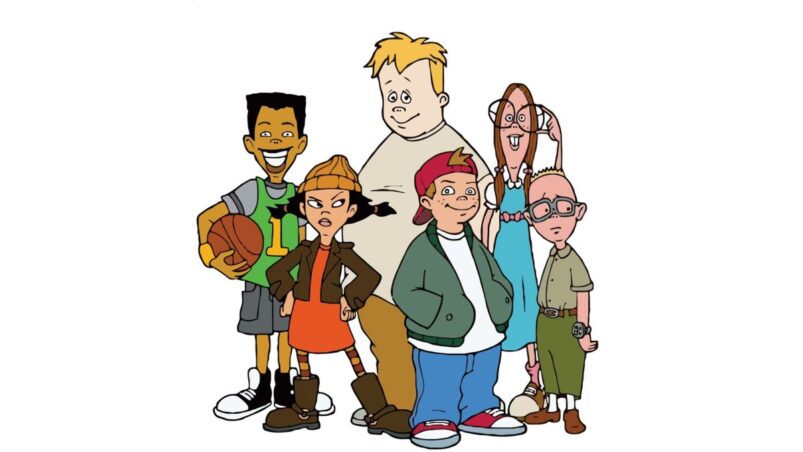
I became aware of Recess via early-morning children’s shows on ITV, which was at the time Disney’s beachhead into British terrestrial television – Recess was just one in a whole bloc of their output. Perhaps what made it stand out, though, is that it was an original property, rather than a TV spinoff of one of Disney’s films (although it was robust enough to later spawn a theatrical release and three direct-to-videos of its own).
The setup itself gives this away. It’s not Disney’s take on a Greek myth or a beloved children’s book, so clearly not wanting to rock any boats they plumped for fairly ordinary American children, at an ordinary, contemporary American school, in that evergreen setting of nonspecific American city. Wikipedia places it in Little Rock, Arkansas, which in Clinton’s ‘90s was literally America’s backyard.
Likewise, the central Recess gang was pure ‘90s diversity. Of their six-strong gang, two were girls and one was black, which by that decade’s standards might as well have been all the colours of the rainbow. And, given the way the show’s millennial audience turned out, more than one will almost certainly have been retrospectively interpreted as gay.
Now, let’s not mess around – Recess was obviously drawing upon The Simpsons’ schoolyard scenes at Springfield Elementary. And in a way it was wearing this on its sleeve, actually going so far as to call one of its employees of the school system Skinner. Any TV-watcher of the late ‘90s who was paying even cursory attention would surely think “wait a minute…”
You couldn’t say it would never have come to be without The Simpsons. There’s plenty of similar plots, but they’re ones you would inevitably arrive at when left to work with the natural dynamics of a school backdrop – bullying, detention, popularity, precocious crushes – though, it must be said, they were set in the same sort of slightly elastic cartoon world. Nobody got turned into an accordion like Looney Tunes, but the child characters might end up having a day in court, or have the feds come after them, or discover something incredibly important. It all existed in a kind of elevated reality.
Recess was one of those children’s cartoons which had a little something for the mums and dads, including pop culture references that a young audience probably wouldn’t get. One that sticks with me was grouchy teacher Miss Finster aping the “I love the smell of napalm in the morning” scene from Apocalypse Now, a three-hour Francis Ford Coppola war epic which no tot should be exposed to.
In fact, it’s particularly odd this gag turned up on Recess rather than The Simpsons – Springfield’s Principal Skinner was a Vietnam veteran, and went through a number of troubling flashbacks which were also openly drawing on Apocalypse Now. Like so much we’re talking about here, this was pure ‘90s, the men who were once twenty-something jungle fodder becoming the forty-something squares they probably once declared they would never be.
So, as we see, The Simpsons too was fond of its pop culture references, and, more importantly, also transcended age groups. More successfully, if anything, being one of the first mainstream cartoons not to be ghettoised as something exclusively for children. Pretty much every age bracket could find something to enjoy in The Simpsons, and any ‘adult’ material was handled deftly enough that the censors couldn’t (or at least didn’t) run wild on them for it. Per example, the wonderful sign gag we see on Springfield’s sperm bank, which bears the motto “put your sperm in our hands”.
Another clear parallel is the robust supporting cast. Again, The Simpsons didn’t invent this, with creator Matt Groening pointing to Canadian sketch comedy show Second City Television as their inspiration – but nonetheless this became a distinct part of The Simpsons’ method, with their wide range of secondary characters allowing them to turn their hand to pretty much any plotline they cared to.
If they’re down at the shore, they run into nonspecific boatman Captain McAllister, and if there’s an episode of political intrigue, their venal Kennedy-alike Mayor Quimby will show up. And although Recess was by and large restricted to the schoolyard, it managed to feature children and staff members from most walks of life – I point again to its ‘90s diversity, a dizzying array of white ethnics and a South Park-style token black kid.
While Recess’s main gang aren’t all direct, one-to-one comparisons to the children of Springfield, there’s enough similarities to be going on with. TJ, the rebellious leader of the gang, clearly has a Bart-borne idea of ‘90s cool in his DNA. Gretchen’s uncanny intelligence could obviously be likened to Lisa. Gus, a slightly pathetic figure with a tough, militaristic father is something like Ralph Wiggum played straight. And Mikey, bigger than the rest and with a poetic bent, may be gentler than but is not a million miles away from sensitive bully Nelson Muntz.
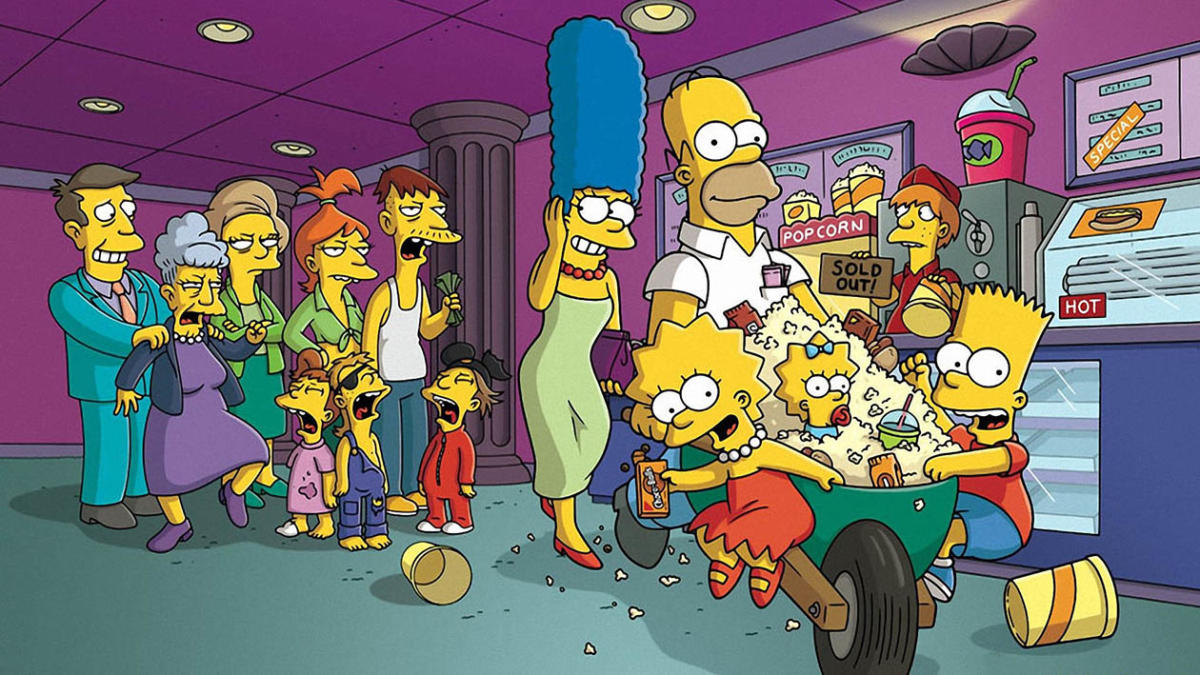
The Ashleys – four popular girls named Ashley – are remarkably like the upper-crust set Marge tries to winkle herself into in ‘Scenes From The Class Struggle In Springfield’, a title which should give you some idea of their place in the show’s dynamic. Uppity, bordering on catty, they represent the slice of society in which you the viewer do not belong and are not welcome.
Even Quimby himself has a schoolyard counterpart, older boy King Bob, who would occasionally issue tyrannical edicts or settle disputes Solomon-style – though really, this is little more a link than their position in this closed-off cartoon society. Contra Quimby’s naked corruption, Bob was a generally reasonable overlord, who was at least trying to do right.
Here, at last, we’ve come to a clear point of difference. The Simpsons was willing and eager to send up authority figures – Recess made their authority figures honest people. Even the nasty teachers (and ‘Principal Skinner’ vs. ‘Principal Prickly’? Come on) were at least genuinely devoted to running the school, whereas the employees of Springfield Elementary were often too apathetic to even be sadistic.
Still, Recess was willing to engage with actual state authority in a way surprising for a Disney production – as I mentioned earlier, the feds came for members of the main gang now and again, and as such weren’t necessarily the good guys. There was no active malice to it, they were (as however many Germans once claimed) just doing their jobs, but still, coming from quasi-fascist state religion Disney, this might as well have been burning the flag in order to light a spliff off it.
This is perhaps a side-effect of having a show as anti-authoritarian as The Simpsons in its genes. One episode had the school administration actually ban recess, and the children quickly became fractured bovine shells of human beings, in much the same way as the students of Springfield elementary did when forced to wear uniforms.
Speaking of other fictional school systems, though, Miss Finster was a fairly shameless reskinning of Miss Wormwood from Bill Watterson’s Calvin & Hobbes, widely regarded as one of the best newspaper cartoons ever and a work which took a subtly subversive tone much like that of The Simpsons. As a figure Finster is visually too similar to Wormwood not to notice, which is perhaps because Watterson was unlikely to sue.

(Watterson is and always has been outright disdainful of the idea of licensing his work, once saying “Note pads and coffee mugs just aren’t appropriate vehicles for what I’m trying to do here” – so any Calvin & Hobbes merchandise you might see is definitely a knockoff, not least those decidedly bootleg mudflap decals of Calvin urinating.)
And in a particularly brazen development, Miss Finster had an exact parallel with The Simpsons’ Mrs Krabappel in that both ended up in a romantic entanglement with another member of staff, and both ended up trapped in the school after hours with their amour, slow-dancing in the empty cafeteria, as our child protagonists (naturally, TJ and Bart respectively) looked on with vague disgust. It’s hard not to imagine Disney and Fox’s respective legal teams nervously looking over the parapet at each other – ancient history now, since they’ve been blended into one, like the opposing forces of World War II shaking hands before reassembling themselves in anticipation of the coming Cold War.
I use the comparison with good reason, since there was a seldom-seen but definite bit of Cold War influence to both. The Simpsons – codifier of the early ‘90s – was, apart from a few of the very early Tracey Ullman skits, existing in its aftermath, with America’s existential nemesis vanquished and America itself on the up and up, touching on the reunification of Germany and with a nuclear-armed and dangerous Russia still a fresh memory. More than the mythical Springfield, the Simpsons were living in, and having their post addressed to, Fukuyama’s End Of History.
But Recess, Disney being naturally less cutting-edge, by and large acted as if the Cold War was still going on. This is at bottom popular culture taking a little while to catch up with reality, and Recess never dangled the lurking fear of nuclear armageddon. But, on one memorable occasion, Recess had the main gang become concerned that their hippy teacher was an agent of a foreign power (an unspecified ‘them’) and start monitoring her activities, like a junior McCarthyite club. So if anything, Recess was not so much ripping off The Simpsons, as it was swimming in its wake, trying desperately to live up to the example of its cooler, cleverer, more modern ancestor in a way that it fundamentally never could.

And yet I cannot make all this shameless borrowing a negative criticism of Recess. Not least because, as we’ve been over in some detail, The Simpsons regularly tipped its bonnet to other famous works of fiction, and was itself ultimately a parody of the trite family sitcom. Likewise, Calvin and Hobbes was far from the first comic strip to boil down to a boy and his animal (though this is more traditionally a dog rather than a tiger). Recess may not have been wholly original, but given that it did make some excellent choices in its source material.
However, let’s not necessarily equate Recess with Disney, the company that spawned it. One cartoon is a mere facet in the extensive and ruthless corporate empire that is Big Mouse. And it almost certainly wasn’t the Recess writing staff responsible for Disney’s fairly savage approach to anyone they perceive to be violating their copyright. Disney are notorious for this, lobbying hard at every level to push copyright periods to last longer and longer: the first Mickey Mouse cartoon, ‘Steamboat Willie’, has been due to enter the public domain on four separate occasions (the first in 1955) before the law was changed in the nick of time.
In this way, Disney dishonours themselves. One of their own works is proof positive of the benefits of allowing ideas and archetypes to pass into common ownership, rather than cooping them up with litigation. If Watterson ever saw that Miss Wormwood had been repurposed as Miss Finster, I can only imagine he would have been happy. And The Simpsons, now basically a vehicle for an endless array of merchandise, never came down too hard on their own range of bootlegs (a category in which this reporter includes Family Guy), even when, coinciding with the Gulf War as they did, they quickly became edgy in a way that the creators definitely wouldn’t endorse.
This, after all, was the ’90s – grand culmination of all human civilisation up to that point, the Western world standing proudly on its laurels in a way which could never, ever go wrong.
READ NEXT: 20 Best Game Boy Games of All Time
Some of the coverage you find on Cultured Vultures contains affiliate links, which provide us with small commissions based on purchases made from visiting our site.