


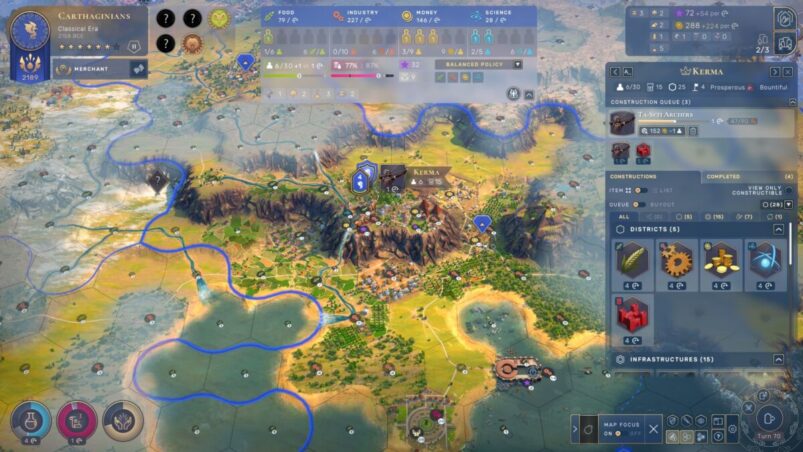
Resource management is a quintessential component of any 4X strategy game, and Humankind is no different. The resources of Humankind will be immediately familiar to any veteran of this type of strategy game, but to help newer players get acquainted with Humankind’s resource idiosyncrasies we compiled a handy guide, covering the main resources found in the game, as well as their effects.
Here are the seven main resources in Humankind:
– Food
– Industry
– Money
– Science
– Influence
– Strategic
– Luxury
And here’s everything you need to know about resources in Humankind.
Food
Food is a vital resource for the growth of any budding civilization, as cities with high food production will ensure consistent and rapid population increase. Food can be tricky to manage, however, especially in the early stages of a city’s life cycle.
For every city, players need to ensure that their population’s food needs are covered, with a surplus of food leading to population growth and a deficit leading to starvation and loss of population. City population can be assigned as farmers to produce additional food and with the research of new technologies, availability of districts, and unlocking new infrastructure projects, cities can produce items to further increase food production.
Food is most abundant around rivers, fertile ground like grassland, or special terrain features like river springs and oases. For high food production, it’s advised to find locations that take advantage of these terrain features.
Industry
The industry or production resource directly correlates to the speed of completing projects in cities. These can be new districts, special quarters like wonders and holy sites, infrastructure improvements, and units.
Unlike food, there is no maintenance cost associated with a city so what players see is what they get for production. Additional population can be assigned to production as workers, which increases the city’s industry rating even further.
Production tile yields can be found on mountains, forests, stone fields, and woodlands. To have a high production city it’s recommended to settle a city near mountains or particularly dense forests.
Money
In some ways, money is the least vital resource as increased gain of money doesn’t directly lead to city improvement. However, money can be used to support construction projects by paying lump sums to instantly complete a project, or to buy access to foreign luxury and strategic resources, as well as help with diplomatic deals or even bribe independent peoples and hire mercenaries.
Money will also be needed to upkeep an army, as every unit has a gold maintenance cost associated with it to model logistics and administrative support. Population can be assigned as traders in a city to increase money gain even further and it also can be gained from war reparations and ransacking vulnerable trade posts, outpost settlements, and sanctuaries.
As money is a human-made resource it’s quite hard to come by from the terrain aside from some luxury and strategic resources giving a native yield money increase. However, there are a multitude of ways to earn money based on player culture choice, technology, districts, and wars.
Science
Science is the simplest and most specialized resource due to it only being used for the discovery of new technologies, and, just like money, isn’t vital to the well-being of an individual city. It does have a more far-reaching effect than food or industry though, as technologies affect the player’s empire as a whole, not just a single city.
Science has no maintenance cost, since technology is an abstract one-and-done system. Players can assign the population in their cities as researchers to increase the speed of technological discovery.
Just like money, science isn’t really naturally produced from the terrain, aside from a few uncommon special terrain features. The surest way to increase science, aside from population assignment, is to construct districts, build infrastructure improvements, and gear their state religion towards science.
Influence
Compared to the previous four resources, influence can’t be found and exploited from the land nor can population be assigned to increase influence production. This resource can only be gained through civics, districts, city and administrative centers, infrastructure, random curiosities, and districts.
Influence is used to place outposts in territories to claim them, evolve outposts into cities, and attach claimed territories to already established cities. Influence is also responsible for widening the empire’s sphere of, you guessed it, influence, a kind of indirect control or cultural effect on territories affected by any given empire.
Influence is one of the most scarce resources, especially early on as the price of founding and attaching outposts increases the further away they are from friendly territory and the more territories a city has already assimilated. Nonetheless it’s a vital resource for expanding an empire.
Strategic
Strategic resources can only be found in the earth and must have an artisan’s quarter constructed over them to gain their tile yields and empire benefits. These resources range from copper and horses, to coal and uranium.
The purpose of strategic resources is primarily to permit the recruitment of units and the production of resource-specific infrastructure. These resources are generally scarce, very valuable, and it’s highly advised to claim and settle on territories that have access to them.
Luxury
Similarly to their practical strategic counterparts, luxury resources can only be found in specific deposits. These resources aren’t vital to unit or infrastructure production, but they are still valuable in their economic effects on the player’s empire. Not to mention some cultures benefit heavily from owning luxury resources.
Though strategic resources should generally take priority over luxuries for their security and production benefits, player’s should definitely aim to claim territories with luxuries where possible to start stacking economic benefits as quickly as possible.
The success of any empire lies in the player’s ability to utilize the land for maximum effect to make their cities economic powerhouses. The following challenge for players is to learn to convert this economic strength into a tangible strategy to gain as much fame as possible and become the most remarkable culture in history.
Humankind is available on PC and Stadia.
READ NEXT: The Best World War 2 Strategy Games of All Time
Some of the coverage you find on Cultured Vultures contains affiliate links, which provide us with small commissions based on purchases made from visiting our site.