


Aside from the highly valuable physical resources like iron or oil, influence is arguably the most important strategic resource in Humankind. It’s also more multifaceted than some of the other city produced resources like food or science and can be confusing to understand the full breadth of its effects. We whipped up a helpful starter guide going over the major uses for influence.
Here are the six main uses of influence in Humankind:
– Settlements
– Wonders
– Civics
– Culture Abilities
– Spheres of Influence
– Independent Peoples
We’ve discussed how to get more influence in our resource guide, so here’s everything you need to know about how to utilise influence in Humankind.
Settlements
Territories can only be claimed by placing down an outpost, a kind of encampment and foundations for a future city or administrative center. Only influence can be used to place outposts, so for any strategy, especially those focusing on rapid expansion, it’s critical to have high influence production. In addition, outposts allow players to place a few districts or move the outpost to a new location in the given territory.
Once placed, outposts have the option of evolving into a full-fledged city or be attached as an administrative center to an already existing city. Both of these actions also cost influence and are substantially more expensive than simply placing new outposts, incentivizing the player to get more influence. With the discovery of new technology, empires will gain the ability to merge cities together, but, you guessed it, that also costs influence.
Wonders
World wonders make an appearance in Humankind, and just like the historical cultures, work in a first come first serve system, meaning there is more choice available to the first few players able to claim a wonder. Claiming wonders begins in the Classical era and requires a sufficient amount of influence to finalize a choice.
Players will have the option of claiming another wonder, if there are some available, but only if they completed their previous one and have an even greater amount of influence. Safe to say, playing the wonders racing game is an expensive proposition.
Civics
Influence is also used to enact laws and social policies that change and affect an empire’s ideology. There’s a huge amount of civics in the game, which progressively become available over time after researching specific technologies.
As players enact new civics they also get progressively more expensive in their cost. It may be wise to be picky with initial civics to enact, especially in the early game, or find ways to increase influence gain to enact more civics.
Culture Abilities
Every culture is associated with one of the seven affinities, which in turn gives them a global ability of some sort. Some cultural affinities, like the merchant culture, have an ability that allows them to spend influence to place an artisan’s quarter on an unexploited strategic or luxury resource in a claimed territory. Be wary though, these abilities become more expensive the more the player uses it.
Spheres of Influence
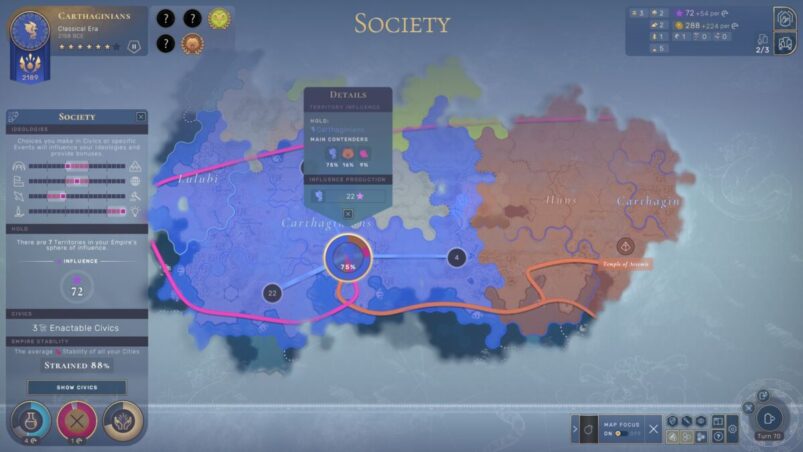
Sphere of influence in Humankind is a term and viewing mode that represents an empire’s abstracted cultural hold or control over any particular claimed territory. To increase an empire’s control over a territory, players would need to not only increase their base influence income, as it represents the overall strength of their culture, but also not spend their stored influence, as that also increases the cultural strength of the empire.
Spheres of influence ebb and flow passively without needing the player’s constant attention and the only way to affect it positively is to increase influence generation. Having a more powerful culture encroach on territory could lead to osmosis events that can change the ideology of the weaker culture, but also lead to grievance generation, which can be used to incite wars.
Independent Peoples
In the Ancient Era and onwards, players will witness the rise of independent states that are too small to raise a hand to the more powerful empires and cultures. These independent peoples will usually try to settle in unclaimed territory and establish a city.
These minor factions can be peaceful or aggressive and may act as bastions or painful thorns if not dealt with. One way of interacting with these independent states, aside from putting them to the sword, is spending influence to improve relations. Once relations reach the maximum threshold, players can choose to spend another lump sum of influence to assimilate the minor faction, in effect taking control of their armies and territory.
Influence really is king in Humankind as it has the most meaningful impacts on the strategic landscape. A good understanding of influence can successfully lay the foundation for an effective strategy. Now that players have an introduction to this vital system, the challenge of finding the optimal path to fame can fully come into fruition.
Humankind is available on PC and Stadia.
READ NEXT: The Best World War 2 Strategy Games of All Time
Some of the coverage you find on Cultured Vultures contains affiliate links, which provide us with small commissions based on purchases made from visiting our site.