

The OG PlayStation made tonnes of headlines. Whether down to its incredible games, the technical standards it established, or the records it set, Sony’s first rectangle of wonders broke through in a big way. But it also had plenty of games that made headlines for some not so good reasons. Sometimes, though, maybe that just helped them reach another level of fame and success.
Carmageddon
Carmageddon didn’t just spark controversy. It backed up, hit the revstick, I dunno, I don’t do cars, and kept driving over it until it was some kinda drama pate.
The PS1 port of the 1997 PC game let players mow down pedestrians and livestock, a mechanic that sent moral watchdogs into pearl-clutching overdrive. Particularly here in Blighty. For me personally, this was the first game that I remember people getting a bit Helen Lovejoy over.
In the UK, the BBFC initially refused classification, calling the human carnage too excessive. For the PS1 versions, retailers couldn’t sell it unless humans were swapped for zombies. Germany went even further, replacing victims with oil-leaking robots.
A British tabloid ran with the headline “Pope wants game banned” referring to MP Greg Pope’s crusade against it and not the guy with the hat. Meanwhile, anti-censorship groups at London’s Cyberia café challenged the BBFC’s ruling, arguing players deserved the choice. Wired documented the debate in 1997 with honestly the greatest headline ever.
After nearly a year of being scrutinised, the BBFC relented, restoring human targets with an 18+ rating, and PC players could download the uncensored versions. Even so, Brazil and Argentina banned it outright.
By the time the dust settled, Carmageddon and its sequels had revsticked their way to 2 million sales. The craziest thing about this? It really isn’t even a good game. It’s actually kinda terrible. Sometimes all you need to do to sell your game is to make wet blankets even soggier, apparently.
Resident Evil
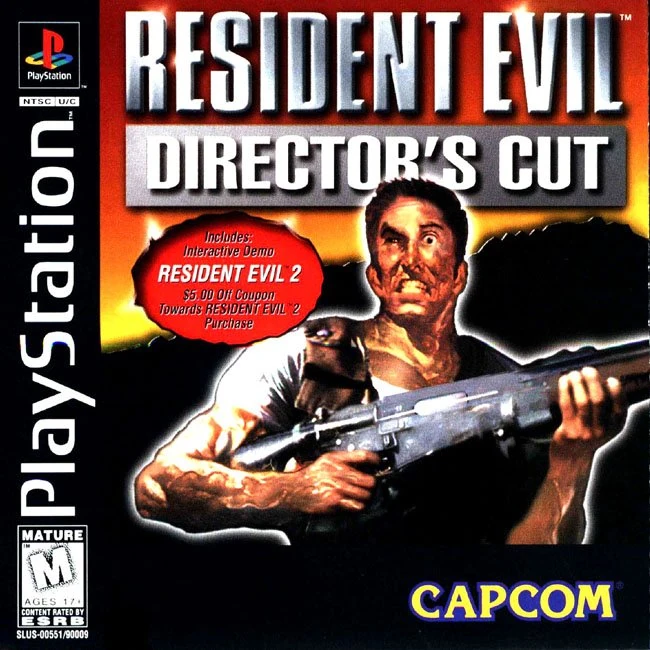
Look, the Resi 1 intro these days is just cheese. Straight up matured cheddar. It’d be quite nice in a sandwich. But back in 1996, it was kinda a lot.
In the Japanese release (you know, Bio Hazard), it’s full-color, showing mangled corpses, a Cerberus dog getting shot, a severed hand, and even Chris Redfield smoking a cigarette. What the hell, Chris.
When it hit North America and Europe in April 1996, Capcom scrubbed it hard: they desaturated the entire scene to black-and-white, cut the blood spray, froze before the bloody hand came into frame, removed the Cerberus gore, and airbrushed out Chris’s cigarette entirely. Don’t they know smoking’s the coolest thing you can do?
Capcom later touted the Director’s Cut version as “uncensored” for Western fans—but it shipped with the same edited intro. It was only after fans complained that Capcom admitted the blunder was due to a localization mix-up and offered the full-color FMV as a free download from their website.
Ultimately, the fuss wasn’t just about gore. It highlighted early tensions between creativity and western ratings systems. In America, the ESRB had only really just been founded, so they were a bit more likely to hold onto their crosses and start screeching.
It’s almost lucky that the OG Resident Evil wasn’t censored even more in the west than it was. Could you imagine the dogs smashing through the windows, but they’ve been turned into like mental health aware chihuahuas or something? Who knows what survival horror would look like today. Would we ever have had this peak of cinema? Would La La Land have actually won the Oscar?
Hey, speaking of apocalypse:
Apocalypse
Friends and long time viewers of the channel will know full well that Bruce Willis once starred in a PS1 game. His literal face, voice, and bald action-hero energy got dropped into a pretty gnarly twin-stick third-person shooter where you mow down enemies in a collapsing dystopia as a dude called Trey Kincaid. Apocalypse is every bit as 1998 as you’re picturing. It even has a System of a Down music video in it, and it is indeed a whipper.
But, at first, Bruce was supposed to just be your AI partner. He’d quip over your shoulder and lend support. But somewhere in development Neversoft upgraded him to the main character. The result? You’re running around as Bruce Willis shouting lines like “Suck on this!” eighteen thousand times cos that’s all they could afford. He absolutely did everything in an afternoon.
Now, Apocalypse didn’t court controversy in the usual “think of the children” way, but it still raised some eyebrows and a few headlines. The game had you blasting religious zealots, a Four Horsemen cult, and hordes of mutants across churches, prisons, and apocalyptic landscapes. There’s even a final boss fight against a Reverend in a cathedral with stained-glass windows shattering around you—not exactly subtle. Given how touchy the late ‘90s were about mixing religion and violence it’s a miracle there wasn’t more pushback.
In hindsight though, the biggest controversy might’ve been how not enthusiastic Bruce’s performance is. God love him, but he’s on autopilot the whole time, delivering lines like he’s trying to get through them before the 1 hour Activision and Neversoft paid for were up. But hey, maybe Bruce walked so Keanu in Cyberpunk could run? He had quite the effect on my childhood, at least.
Fear Effect 2
On paper, Fear Effect 2 is a slick cel‑shaded action‑adventure with a cyberpunk vibe and some light survival horror DNA. Cool! But Eidos went full “broadband doesn’t exist yet” mode and sold it like the world’s first time women had maybe thought about kissing women. On the mouth?!
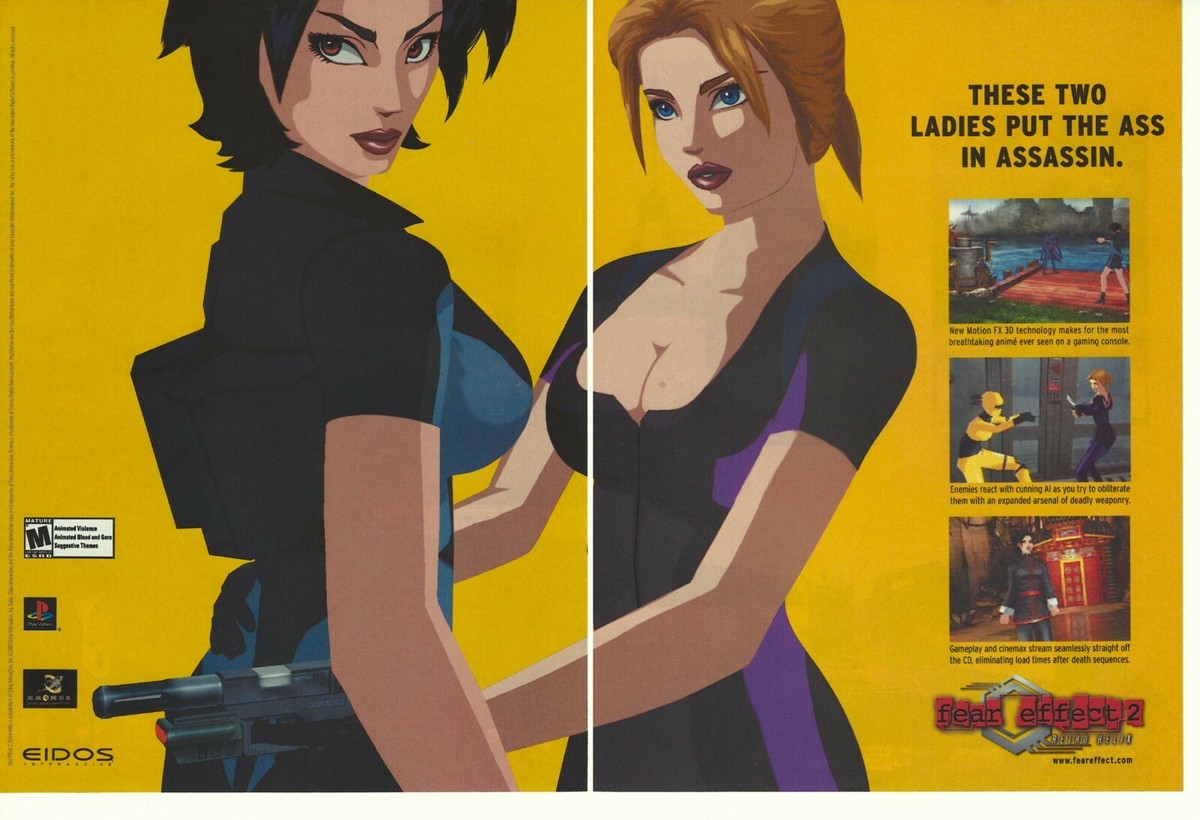
The big hook for the series—at least if you believed the ads—was the relationship between two of its leads, Hana and Rain, which was established in the second game. The actual game only flirts with their romance, but you wouldn’t know it from the trailers and magazine spreads. Steady on.
They leaned hard on the “lesbian lovers” angle, plastering screenshots of the two women lounging in lingerie, half-naked and suggestively draped across each other. One promo even teased “these ladies put the ass in assassin” like some kinda sapphic Sesame Street.
But here’s the thing: Fear Effect didn’t come out of nowhere. Lara Croft had already proved you could sell a game off the back of a badass, hyper-sexualized female lead. Eidos, who published both series, clearly looked at Tomb Raider’s marketing success and said, “OK, what if we make it edgier? And gayer?”
Of course, the games weren’t all that explicit. Sure, there were risqué outfits and suggestive banter, but most of the time you were shooting and solving puzzles—not playing Bound if it was an FMV. Still, the marketing worked.
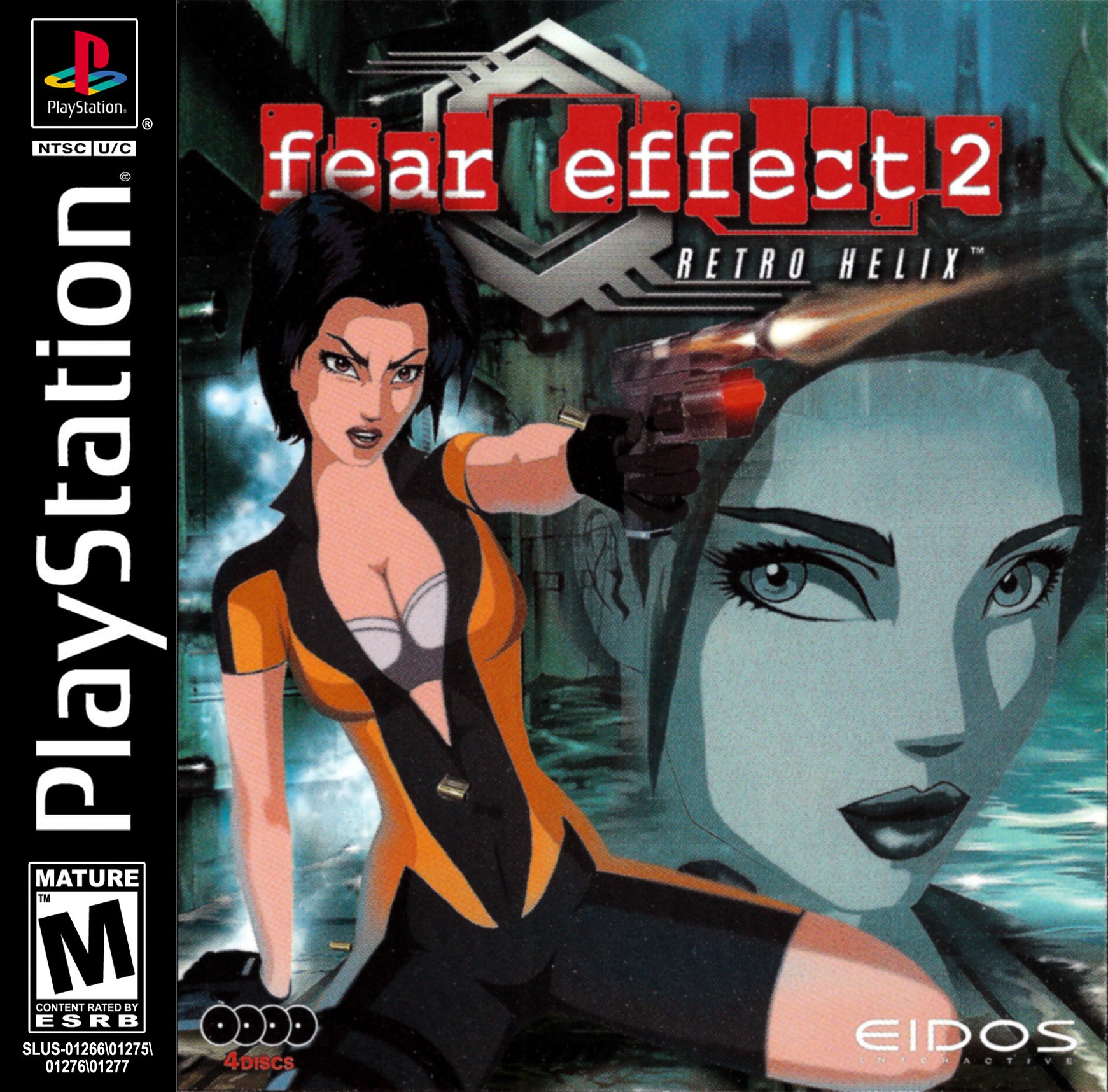
The box art alone looked like something that should’ve been behind peeking out from the top shelf of your local Londis.
Bust-A-Groove
I already mentioned this in our 100 PS1 facts video, which I really do think is a fun time and you should give it your eyeballs if you haven’t, but I simply have to maximise the amount of people who know about the OG Bust-A-Groove release.
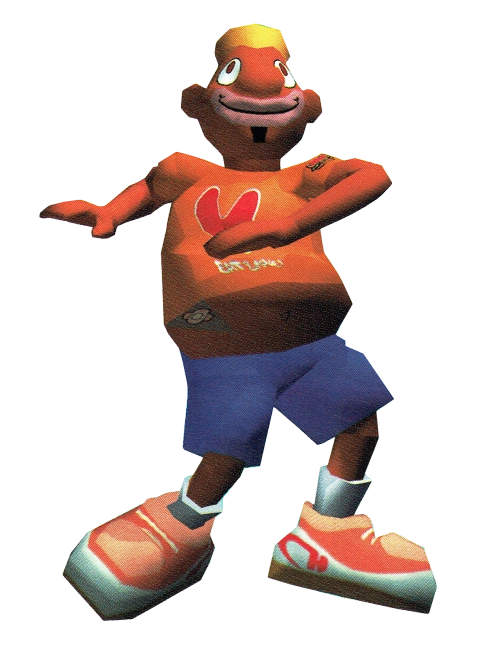
Most people remember Bust‑A‑Groove as this bright, cheerful PS1 dance game, but the Japanese version had one line in Hamm’s song that makes you spit out your hamburger. Out of nowhere, the lyrics drop the N‑word like it’s no big deal.
When they brought the game over to the West, developers Metro quietly just removed the word and called it a day. Looking back now, it’s wild that a Japanese dev thought tossing that word into a feel‑good party game was a cool, “American‑sounding” move.
I am just picturing a bunch of stuffy, underpaid Japanese dudes in suits in a boardroom with a giant whiteboard. On it, there’s a big American flag, a picture of I dunno, Vanilla Ice and a Desert Eagle, and then someone writes the letter N and nobody stops them at any point as they keep adding more letters.
There were a few other edits too—Hiro lost his cigarette, and Strike’s booze got swapped for soda—but honestly, no one cared. A lot of people did care, though, that basically all of the endings in Bust-A-Groove 2 got removed completely over here. That’s not very groovy.
GTA 1 and 2
It’s easy to forget now, especially as your brain makes room for important stuff like what colour bathroom towels you should buy, but the original Grand Theft Auto was controversial before it even launched. Back in 1997, this top‑down crime sim caused moral panics worldwide just for letting players jack cars, mow down pedestrians, and rack up points for general chaos. Prudes!
Here in the UK, still buzzing after hounding Princess Diana to her tragic death, tabloids had a field day. Headlines painted it as the end of civilization. Even police organizations weighed in, saying it glorified violence against officers. But here’s the funny part: the controversy was so good for business that DMA Design leaned into it. They even hired PR agent Max Clifford (yes, that Max Clifford) to fan the flames and make sure every outraged parent in Britain had heard of GTA.
In Germany, the blood and cop-killing missions got toned down. In Brazil, the game was outright banned because it “encouraged criminal behavior”. GTA 2 got similar treatment. Its TV commercials featuring armed gangs roaming a real city were pulled in some markets for being “too realistic” post-Columbine.
Looking back, it’s almost…adorable?. The game that caused headlines worldwide would barely raise an eyebrow today. There’s probably about 12 games like this uploaded to the eShop every week. The gore? Minimal. The swearing? Mild. And the graphics? Well, let’s just say running over stick figures in a pixel car doesn’t hit quite the same as Trevor Phillips lighting up a strip club.
But in the late ‘90s, GTA was public enemy number one, and people have been chatting shite about the series ever since. I would kill to never hear GTA 6 discourse ever again. What a thrill.
Thrill Kill
Thrill Kill wasn’t just controversial—it was so controversial that EA straight-up buried it before it ever hit shelves. And that’s saying something for a game that was basically Mortal Kombat in fishnets.
This was a 4‑player arena fighter where the characters were a line‑up of BDSM fever dreams: Belladonna, a dominatrix with an electric cattle prod; The Gimp, literally a dude in a leather gimp suit on stilts; and Cletus, a cannibal hillbilly carrying a severed limb like a baseball bat. Every match ended with “Thrill Kills”—gloriously over‑the‑top fatalities with names like “Swallow This” and “Bitch Slap”.
Needless to say, this didn’t go down well in 1998. The American ratings board gave it an AO (Adults Only) before release, meaning most stores wouldn’t touch it. But the real death blow came when EA acquired Virgin Interactive, inherited the game, took one look at it and said nah. They called it “morally reprehensible” and cancelled it outright. Sort of.
You see, the story doesn’t end there. Somehow now under Activision’s wing, developers Paradox Entertainment weren’t about to waste their leather children. Eventually, they slapped Wu-Tang Clan branding over the whole thing, tweaked the characters, and rebirthed it as Wu-Tang: Shaolin Style—a hip‑hop themed fighting game that actually shipped and was actually…alright? Not quite nice.
Thrill Kill feels like a perfect time capsule of late‑‘90s edge where it was just more of everything, and make it louder. Thanks to emulators, you can find out for yourself if the game is a thrill or not pretty easily. It’s definitely something!
Galerians
Galerians is one of those PS1 games that somehow flew under the radar at the time, but I’ve mentioned it so much now that you’d think I’m getting paid. On the surface, it’s a survival horror game with a sci-fi twist that you could call a Resident Evil clone, except you are the Umbrella experiment. You play as a psychic kid named Rion who wakes up in a hospital with amnesia and the ability to melt people’s brains with his mind. Cool, right?
But here’s the kicker: to actually use your powers, you have to pump Rion full of drugs. Literally. There’s a whole mechanic built around injecting yourself with syringes full of chemicals like “DELTA” and “APOLLO” to keep your psychic abilities juiced. Overdo it and Rion goes into “Short” mode, a berserk state where his powers explode out uncontrollably—and you fry everyone in the room, friend or foe. S
While it never caused a Mortal Kombat-level moral panic, there was definitely unease about its themes in some regions, and got the odd pearl-clutch from ratings boards. PAL territories slapped 18+ stickers on Galerians, and the Japanese version had certain violent FMV sequences toned down before export.
The tone of Galerians also didn’t help. The whole thing feels drenched in bleak, clinical unease—sterile hospital corridors, creepy voice acting, and an oppressive soundtrack that sounds like someone banging on a radiator in hell. It’s more unnerving than straight-up gory, but it still gave plenty of players nightmares.
In hindsight, it’s kind of amazing that this ever made it to Western shelves without all of the newspapers screaming “Games Make Your Kids Into Junkies” Maybe they were too busy yelling about GTA.
Right, let’s talk about cars again. Cars have gears, right.
Xenogears
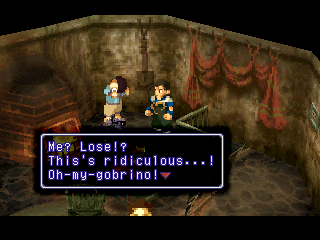
Xenogears is a banger of a PS1 JRPG that feels like it was written by someone who read The Bible, hardcored binged Neon Genesis Evangelion, and said “what if I mashed these together but made it 70 hours long?” It’s a Square classic, but it’s also amazing it ever got past Western censors with as much of its original content intact as it did.
You’ve got crucifixion imagery front and centre (there’s a whole bunch of crucifixion at one point), a villain called Deus who’s basically a space god, and a plot that pulls no punches about religion. Kinda risky business all round.
Square’s localization team clearly scrambled to soften stuff in places. The original Japanese version uses “God” and “Yahweh” repeatedly, but the English script swaps them for more vague terms like “Deus” and “The System” in certain scenes. A few particularly spicy religious lines were toned down or cut entirely, and a line where a character straight-up accuses the church of being corrupt was, shall we say, massaged into something less inflammatory.
Even so, the religious themes and imagery remained front and centre, even with some absolutely stupid changes. A lot of players definitely noticed, but some US magazines danced around the heavier stuff like it didn’t exist. Some translators even stepped away from the project due to how heavy it got.
Looking back, Xenogears feels like one of those rare moments where a game got away with being way more provocative than anyone realised at the time. If it came out today, people absolutely wouldn’t shut up about it, and the ragebait would set records. But at least people would be talking about Xenogears, I guess?
Loaded
Fact: you weren’t allowed to play Loaded back in the day if your room didn’t at least smell faintly like ballsack. It’s a top-down shooter that’s as subtle as a brick through a shop window, with an aesthetic that screams “what if Smash TV, but everyone likes leather a bit too much?”
You play as one of six villainous inmates who’ve broken out of a space prison. Fwank, which I love, Butch, Bounca, Cap’n Hands, Mamma, and Vox. Every single one looks like the result of a Slipknot fan designing a character in MS Paint. And the goal? Literally shoot everything. Guards. Civilians. Walls. It’s all fair game, and it leaves behind blood and perhaps bits of sick that were extremely edgy for 1995.
Of course, this wasn’t going to slide by unnoticed, and there were a few concerned arm crossings going on around it. In truth, it’s not that controversial, but it’s actually here for anecdotal reasons. My stepfather found me playing this one time, after I’d bought it with my own money, and got so mad that he took it away from me, saying I was too young for such a sick game.
In hindsight, Loaded feels like it was built in a time before developers knew how to do “mature content” without just bathing everything in gore and noise. It’s messy, loud, and pretty juvenile—and somehow that’s its charm.
It’s got some good lighting stuff going and can be fun in bursts, but it’s overall not amazing. It’s one of those “I can’t believe my parents let me play this” PS1 relics that sticks in your brain forever. Well, not for me, but hopefully for you! There was also ReLoaded and a comic book series, if you wanted to get into the, uh, Loadverse?
READ NEXT: Dark & Disturbing RPGs You Should Play
Some of the coverage you find on Cultured Vultures contains affiliate links, which provide us with small commissions based on purchases made from visiting our site.