
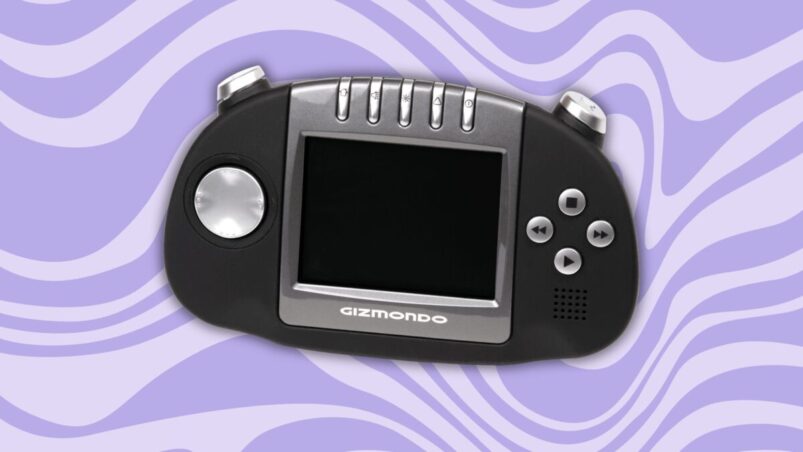
It’s a tale as old as time. Or, well, as old as capitalism, at least: business executives get caught on the hype train for something and proceed to blow millions on the project, only for it to fall well short of the smash hit they expected it to be. This is the story of the Gizmondo.
The Road to Handhell
The convoluted story of “the worst console of all time” begins with Carl Freer, a Swedish businessman who founded Eagle Eye Scandinavian in 2000. Freer wasn’t lacking in ambition, but he was lacking in moral scruples — having once been caught forging his parents’ signatures on loan documents when he was only 18. He went on to wreak havoc in Sweden’s business world, racking up massive debts and leaving behind a trail of 14 company bankruptcies.
After rolling a nat 20 on a persuasion check in 2002, Freer somehow managed to convince Floor Décor, a Floridian carpet company, of all things, to merge with Eagle Eye, forming Tiger Telematics.
Joining Freer was an acquaintance named Stefan Eriksson, who Freer had met in the late 1980s. Out of all the major players in this story, Eriksson had the biggest rap sheet. Despite a fairly normal childhood, Eriksson — then known as “Fat Steffe” — dipped his toes into the outlaw life at the age of 19 with a series of burglaries. From there, he eventually became the boss of the Uppsala Mafia, where he had his fingers in ventures like drugs and weapons.
Eriksson found himself on the wrong side of the law throughout the 80s and 90s, and developed a reputation for being violent — having once shoved a gun into a man’s mouth while threatening to cut off his fingers. And following his arrest after trying to defraud a bank, the primary witness in the case survived two targeted bombings.
Despite being sentenced to a decade in prison, Eriksson was released after only about six years. It was at this point that he reconnected with Freer, and found his way into Tiger Telematics.
Beyond Eriksson’s penchant for violence, he was a man of money, and made sure the world around him knew it. He drove expensive cars, proudly displayed his personal raceboat in downtown Uppsala, and flaunted his wealth in any other way he could. A habit that he would take with him — along with Uppsala Mafia members Johan Enander and Peter Uf — into his tenure at Tiger Telematics.
Rounding out our starting cast of characters is Michael Carrender, a member of a conservative fundamentalist religious sect originally known as the End Timers (who, among other things, believed newspapers to be instruments of the devil) before being renamed to Meade Ministries. Carrender was brought on as chief financial officer, at which point he helped transform Floor Décor into Tiger Telematics. He would later be named CEO.
To fully understand how the Gizmondo came to be, however, we need to briefly set the scene. The early 2000s were a different time: smartphones had yet to take over the world, and personal digital assistants were on their way out. The space for multi-purpose devices was, at that point, essentially vacant.
Meanwhile, the DS and PSP dominated the handheld market by the end of 2004, and competitors like the Nokia “Taco Phone” N-Gage and the Tapwave Zodiac fell by the wayside.
More importantly, at the time, England was grieving the deaths of two young girls — Holly Marie Wells and Jessica Amiee Chapman — who were murdered in Soham, Cambridgeshire in 2002. Seeing this, Freer began brainstorming ways to help parents track their children’s whereabouts via GPS technology.
One of the hurdles that Tiger Telematics had to overcome was, of course, the value proposition. How do you convince your kid to carry around a device that puts them under 24-hour surveillance?
The Marketing Train Goes off the Rails
The answer, Freer decided, was to make it “fun.” Initially announced as the Gametrac, the Gizmondo was a digital swiss army knife. It would be packed with features — beyond the games and GPS support, it could handle SMS messaging, video and music playback, and even Bluetooth connectivity. For consumers, this was positioned as the next big thing in tech. For Tiger Telematics, this was their way of pushing into a market dominated by Nintendo and Sony.
Tiger Telematics came out swinging in 2004, showcasing the device at events like CES and E3. For all of the then-cutting edge features stuffed into the Gizmondo, its marketing was even more extravagant. Its CES debut had even been handled by Microsoft rather than Tiger themselves, as the Gizmondo used Windows CE as its OS.
An entire subsidiary, Gizmondo Europe, was formed to market the device, and they poured an absurd amount of money into these efforts. Together with the force of Freer’s sheer charisma, a promotional blitz to hype up the Gizmondo began.
No expense was spared in this effort. They sponsored the Jordan Grand Prix, they hired Ogilvy PR for global marketing, and they signed an advertising agreement with MTV. Most famously, Gizmondo opened its own dedicated store on London’s Regent Street, had Eriksson participate in the 24 Hours of Le Mans race with a Gizmondo-branded Ferrari, and threw a lavish £1 million launch party featuring a bunch of celebrities and musical talent — a launch party that was also broadcasted by MTV. They had even signed deals with several studios to produce games for the system.
So sure were they of the Gizmondo’s success, that Tiger already had a lineup of alternate models in the works: one that would focus on the GPS functionality, one that went all-in on gambling, and one that was geared towards a female audience.
And at first glance, it seemed like Gizmondo’s charm offensive was really working. Outlets like IGN were impressed with what the Gizmondo was capable of, while big third party companies like Ubisoft, Sega, and Microsoft all announced their support for the system’s library. A first party game, Colors, was positioned as the console’s killer app, being a GTA clone that incorporated the system’s GPS features into gameplay.
It wasn’t long, however, before the house of cards started to crumble. The Gizmondo launched on March 19, 2005 with a retail price of £229. At that price, the system needed to move over 4,300 units just to pay for the big celebrity party. The Gizmondo did manage to completely sell out on launch day at its dedicated retail store. But since only 1,000 units were allocated there to begin with, breaking even was never going to happen.
U.S customers, meanwhile, weren’t enthused with the planned launch price of $399. For context, the Nintendo DS launched at $149, the PSP at $249, and the Nokia N-Gage at $299. No matter which way you sliced it, charging the same price as the Xbox 360’s 20 GB model for a handheld like the Gizmondo was going to be a tough sell.
Not helping matters was the fact that Gizmondo planned to launch a cheaper model that would force players to watch ads. Priced at £129/$229, the “Smart Adds” model would show targeted advertisements to users up to three times a day. This turned off even more potential buyers, but those who bought it anyway would find that, ironically enough, the advertisements were never activated in any region. They’d gotten the system at a discount with no strings attached.
Gizmondo would continue shooting itself in the foot by announcing a new widescreen revision one month before the original had launched in the U.S. In a prime example of the Osborne effect, any potential buyers that were left decided to wait for the newer model instead of buying the one about to launch.
For anybody in the UK or the U.S looking to buy the system, they wouldn’t find it at the usual game stores. The UK had online vendors, high street retailers, and Gizmondo’s own store, at least, but American buyers could only find the Gizmondo at a dozen dedicated mall kiosks scattered throughout the country. Up to 38 more were planned, but whether they were ever actually opened, we’ll never know.
This, according to Freer, was because the Gizmondo “was comprised of over 260 components, he says, many of which had long lead times.”
Yet another hurdle for the Gizmondo was its lack of games. For all of the money that was spent on courting developers, including EA for their FIFA titles, the system itself had an abysmal launch lineup, and the situation would never improve. Out of all the games on the system, it was only really the puzzle game Sticky Balls that made a splash. The majority of the 89 titles promised for the system, including killer app Colors, simply never materialized. The UK got 14 games, but only 8 of those made their way to the U.S.
Among the many games that vanished into the ether, at least some were actually ready to ship, only being cancelled due to issues on Gizmondo’s side. One such title was Hit & Myth, and according to Anthony Salter, one of its programmers, the game suffered setbacks due to Gizmondo refusing to pay for X-Forge, the engine that powered the game’s anti-piracy measures and other utilities. The studio had to rewrite all of those features themselves after stripping X-Forge from their game.
By the time Hit & Myth went gold in October of 2005, Gizmondo just didn’t have the money to publish it, and struggled just to pay its developers on time. For developers like Salter, the writing was already on the wall.
Stuttering at the Starting Line
After all of the hype and controversies, the Gizmondo only moved 25,000 units worldwide — firmly ensuring its place as the worst-selling handheld console in history. And the specialized models and the widescreen revision? Yeah, those never made it to market either.
Reviews of the handheld itself, both contemporary and retrospective, weren’t exactly glowing, either. Most of those who got their hands on the thing didn’t have much positive to say about the system’s ergonomics, and that’s before getting into the fact that the tech just wasn’t at the level needed for a smooth experience — good luck trying to send texts without a proper keypad. The few games that were available, especially in the U.S, were also lambasted. The consensus, it seemed, was that the Gizmondo tried to do too much, and did nothing particularly well.
It was also at this point that Tiger Telematics and Gizmondo Europe started to come undone, falling apart by virtue of their excessive spending and promotional tactics that, in hindsight, weren’t completely on the up and up. Gizmondo’s partners, including Jordan Grand Prix, Ogilvy PR, and MTV all sued the company for millions, alleging that Gizmondo never held up their end of the bargain. A marketing executive who worked under Freer and Eriksson claimed that Freer effectively scammed his partners for free publicity by getting deals with big companies and issuing press releases about the collaborations, only to not actually honor their agreements.
Meanwhile, Freer tried to stem the bleeding of more than $200 million in losses by issuing more shares via the pink sheets system. Floor Décor’s — and ultimately Tiger Telematics’s — shares were traded via pink sheets (or over-the-counter trading) in the U.S, meaning there was less regulation and oversight. This was one of the reasons behind the merger to begin with, but as with Freer’s other efforts throughout this whole saga, it backfired, since flooding the market with shares just ended up diluting their value.
Eriksson, meanwhile, was often absent from the office, and when he did show up for meetings, he spent them sitting there reading car magazines.
It’s worth noting that, as you’d probably expect from the people at the top of the food chain in this business, Freer and Eriksson both paid themselves massive salaries, and went on even bigger spending sprees. Despite the already-expensive promotional tactics of Gizmondo and the dire straits the company found itself in, the two were eager to shell out millions of dollars for multiple homes, a yacht, cars, watches, and all other manner of luxuries.
Further scrutiny also showed that among the many companies and studios that Gizmondo made deals with, several of them, like Northern Lights Software and Game Factory Publishing, were entities that Freer and Eriksson either owned a part of, or otherwise had some sort of pre-existing ties to. Freer and Eriksson were, in essence, paying and making deals with themselves.
Freer’s and Eriksson’s lavish lifestyles only escalated when the two moved to the U.S. On paper, their move in spring of 2005 was so they could help oversee the American launch of the Gizmondo. But the fancy mansions, yacht, and a new startup called Xero Mobile made it clear that the two had seen the writing on the wall and were already preparing to leave Gizmondo behind.
It’s in late 2005, however, where the story starts to take a truly wild turn.
One Wrong Turn at 194 MPH
In October that year, Freer, Eriksson, Uf, and Enander all resigned from their positions at Gizmondo. Days later, Aftonbladet, a Swedish newspaper, published an exposé that broadcasted the latter three’s mafia ties and criminal pasts to the world. The four had seen this coming, and Freer in particular believed that resigning would help keep Gizmondo out of the crossfire (it didn’t). CEO Michael Carrender, who was left behind to clean up the mess, was blindsided by the news.
Gizmondo Europe finally came crashing down in early 2006, with the company filing for bankruptcy in the UK. When all was said and done, the company had accrued losses of $300 million USD. The Gizmondo itself was officially discontinued in February, and the dedicated store on London’s Regent Street was closed down.
That wasn’t the only crash that happened, though. In February that year, Eriksson and Irish-American Trevor Karney hopped into a Ferrari Enzo (which, we might add, has only had about 400 units ever produced) for a bout of reckless drunk driving along the Pacific Coast Highway in California.
After hitting speeds of around 194 miles per hour, or about 312 kilometers per hour, Eriksson lost control of the car and struck a power pole after skidding sideways. Despite the crash being violent enough to tear the car in half and send its engine flying, the two men somehow walked away mostly unscathed. Eriksson himself only had a bloody lip to show for the experience — though his own troubles didn’t end there.
In April of 2006, after learning that Eriksson was planning to hightail it out of the country, Los Angeles police raided his home and arrested him. Eriksson, already on thin ice from the crash, faced even more charges thanks to officers finding a revolver in his home. What’s more, the Bank of Scotland claimed that the Ferrari was theirs. They’d leased it to Eriksson, only for him to stop making payments after a few months. Other banks from Europe also came forward, claiming that Eriksson had defaulted on the leases for their cars as well and illegally exported them to the U.S.
A mistrial ultimately allowed Eriksson to dodge grand theft auto charges, and he took a plea bargain on embezzlement and illegal gun possession, serving three years before being deported back to Sweden, where he wound up doing another 18 months for an unrelated case of extortion and assault.
Freer, for his part, was arrested for illegally owning a dozen rifles, impersonating a police officer to buy guns, as well as claiming to be a member of an “antiterrorism squad”. Though his mansion and yacht were raided in the process, he somehow managed to worm his way out of serious legal trouble, and is still active as a businessman to this day.
Thus ends the tale of the Gizmondo, a project destroyed by technical flaws, horrendous financial mismanagement, and good old fashioned corporate hubris. A company that once had aspirations of competing with the titans of the gaming industry collapsed under a mountain of debt topped with criminal controversy.
The Gizmondo handheld itself, owing to its now decaying rubber texture for the outer casing, and abysmal lifetime sales, finds itself becoming a rarer specimen with each passing day. Collectors who are fortunate (or unfortunate, depending on your view) enough to get their hands on one compare it to “holding dead flesh” — and some units have been overtaken by mold.
At least that Ferrari Enzo had a happy ending. Ferrari went on to fully restore the thing, and sold it for a hefty $1.75 million at an auction. If there’s something that can be learned from this whole debacle, it’s that you shouldn’t spend all your money before your product has even made a profit. That, and don’t join the mafia. Or drink and drive.
READ NEXT: 50 Best Sega Genesis Games of All Time
Some of the coverage you find on Cultured Vultures contains affiliate links, which provide us with small commissions based on purchases made from visiting our site.