


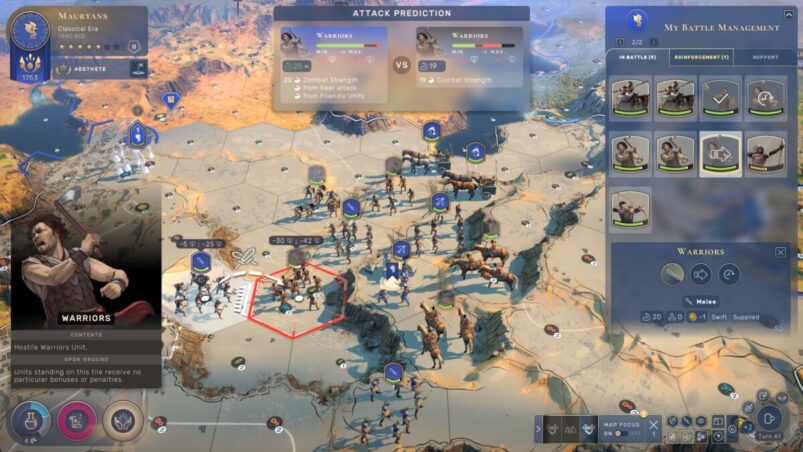
Humankind has one of the most fun combat systems of any historical grand strategy game. In concept, it’s quite simple, but in practice there are a number of complexities that players will need to consider to utilize the tactical combat mode to its full potential. This introduction covers the vital components to help new players come to grips with how combat in Humankind works.
Here are the six main components of combat in Humankind:
– Armies
– Units
– Terrain
– Positioning
– Reinforcement
– Strategic Warfare
Humankind’s tactical combat triggers when two opposing armies meet on the strategic map. Once both sides decide to stand, a tactical combat zone is formed around them on the strategic map, which directly incorporates the terrain features found on said map.
Players will deploy their units and fight until the battle rounds run out, complete destruction of one side, or the capture of a victory flag by the end of a strategic turn. Vitally, battles can last multiple strategic turns, so players need to prepare their troops and their tactical thinking accordingly.
Armies
When operating on the strategic map and out of any tactical combat, units will be grouped into armies. At the start of the game, an army will be able to hold a maximum of four units, but this limit can be increased through technology or specific cultural features. Once two or more armies meet in tactical battle, they will “unpack” and all units within the army will be available for deployment.
Units
Units of various kinds will be the primary tools players will use to engage in combat and fight their wars. Every unit has five primary components: strength, range, movement, zone of control, and abilities.
The strength of a unit represents an abstract rating of the unit’s combat ability. Units with a higher strength are more likely to deal an increased amount of damage to units with lower strength, so it’s beneficial to engage enemy weaker units with stronger friendly ones.
All units will have a range rating, which represents the distance at which they can attack. Most melee-weapon equipped units can only attack adjacent tiles and will take retaliation damage, but some units equipped with ranged weapons will be able to attack from one or more tiles away without taking retaliatory fire. However, most ranged units will require an unobstructed line of sight to their target.
The movement rating represents the maximum distance a unit can move before ending their turn. Important to note: normally if a unit performs an attack action against an enemy, afterwards their turn ends immediately, even if the unit had movement points left over.
Every unit exerts a zone of control around them to every adjacent tile. This means that when a unit moves into the zone of control of another unit, they will have to end their turn, as they become engaged or pinned.
Units will also have a variety of abilities that give them a unique role in combat. Most abilities are tied to a unit class, but there are a slew of units, especially cultural emblematic units that have unique abilities to spice up the tactical battlefield.
Terrain
Arguably the most important factor to consider in combat is the geography of the battlefield. In fact, it can be so impactful that it can single-handedly flip engagements on their head and create unexpected outcomes.
There are five main terrain features to consider in battle: high ground, rivers, forest, cliffs, and urban. A unit attacking from a higher level of ground or defending against an attack from a lower level will gain a significant combat modifier and can ensure that a weaker unit fights on equal terms even against stronger units.
Rivers can be quite dangerous as they reduce the combat strength of a unit standing on a tile with a river. It would be wise to not get caught on a river as it can severely weaken units, but with good positioning, rivers can be an excellent barrier or protective feature.
Forests add a defensive bonus to units when attacked by ranged fire. Otherwise, forests are treated almost like open ground, but they may also make movement more difficult if the player isn’t careful.
Cliffs have no direct combat modifier effect, but instead act as solid barriers that block movement. Ranged units can benefit from finding a good position protected by a mix of rivers and cliffs as they are generally weaker in melee and could benefit greatly from every bonus to their strength they can get.
Urban terrain can be further classified as built-up terrain and fortifications. The former gives a bonus to defence, while the latter gives an even greater defensive bonus and even more so, some emblematic fort districts can give further combat bonuses to units if adjacent to said fortification.
Positioning
Effective use of formations and facings can also help players gain an edge over a difficult opponent. Units can gain two bonuses for positioning and facing: adjacency and rear attack.
Units gain a combat bonus when positioned adjacent to another friendly unit, indicating a boost to their morale and tactical support of each other. Rear attacks give a massive bonus to an attacking unit if they are engaging a unit that is facing away from them.
Reinforcement
Once players research the Standing Army technologies, they will gain the ability to bring multiple armies into a battle and bring reserve armies into an ongoing engagement. When the initial tactical deployment zone is calculated, any friendly army in that zone will automatically be included and available for deployment.
Armies outside of a tactical engagement can join in by simply moving into the designated combat area. However, friendly armies can only reinforce on the player’s turn within the specific tactical battle.
Strategic Warfare
Moving into the Industrial and Contemporary eras of the game, the increasing power of artillery and the development of aircraft (not to mention nuclear weapons) unlocks an entirely new dimension to combat. Due to the increasing range of artillery and farstrike capability of airplanes they may not be able to directly deploy and participate in a tactical battle.
However, such units will be able to make attacks on the strategic map by either directly damaging units or even striking at structures and installations. This way players can affect not only the tactical, but also the strategic landscape in their bid to gain an advantage in war.
Combat can get quite complex in Humankind, especially with the discovery of new technologies and the development of deadlier tools of war, not to mention crazy situations such as amphibious attacks or long sieges. However, the fundamentals of combat will maintain their relevance regardless of the age players find themselves in. It’s up to the players now to utilize the knowledge of these fundamentals to bring fame and glory to their empire.
Humankind is available on PC and Stadia.
READ NEXT: 20 Best Sci-Fi Strategy Games of All Time
Some of the coverage you find on Cultured Vultures contains affiliate links, which provide us with small commissions based on purchases made from visiting our site.