

The PS1 lived a long and fruitful life. But even as it started to look a little like Bilbo in Return of the King, it was still pumping out games as the PS2 whirred into gear. Fair warning: some of them are the video game equivalent of my reaction when I’m anywhere near custard creams. But not this first one.
C-12: Final Resistance (April 6, 2001)
C-12: Final Resistance is one of those games where you either get it or you don’t. I love it, and I think a lot of kids whose parents couldn’t yet afford a PS2 did too.
Built by SCE Cambridge (yeah, the MediEvil lot), it hit Europe on April 6th, 2001, but it didn’t reach North America until July 22, 2002. That’s after GTA 3, by the way. It also ended up being the last PS1 title developed by Sony’s European studio, which is a neat little epitaph innit.
C-12’s set in a moody, post-invasion Earth where you peel back alien hardware and blast through ruined city blocks with a cybernetic eye gizmo, and you get more android bits and bobs as you go. It’s not quite a lost masterpiece, but it has a very heavy atmosphere and really good voice performances.
Critical reception was…fine. Metacritic sits at 63, with reviews praising the atmosphere and visuals-for-the-hardware while grumbling about annoying camera work and dated, Syphon-Filter-ish gunplay. IGN called it “just not that fun” thanks to the camera. But it is beloved by those who played it.
But not many did. Again, this was a PS1 game that landed in 2002. Compared to modern consoles and generations, once the PS2 was out, the support and interest in the PS1 dropped off pretty sharply, and C:12 kinda came across as a bit…old?
But if you were hanging onto your PS1 in 2002, this felt like a proper send-off rather than bargain-bin filler. We’ll see some of that later. For now, X marks the spot. Well, not really.
Mega Man X6 (December 11, 2001)
Mega Man X6 hit the PS1 so late in the day you’d be forgiven for thinking Capcom’s computers had been given the Fry treatment. Capcom did seem to have some trouble letting go of the PS1 though, as the console got Mega Man Legends 2 the year before too.
X6 itself launched November 29, 2001 in Japan, December 4, 2001 in North America, and February 2002 in Europe. That’s a month before the GameCube remake of the first Resident Evil game landed, by the way. This was the sixth Mega Man X game and the last hurrah for the series on PS1, made without Keiji Inafune at the helm, and it shows.
Sales were decent-but-not-earth-shattering. Reviews were on the more mixed side, and the game is a bit polarising still with fans. It sits at 65 on Metacritic, with critics calling out recycled ideas, obnoxious level design, and the “Nightmare” system. Oh yeah. Those were randomised hazards that felt like more of a sadistic prank, and a lot of people think it’s the worst game in the X series because of that and more..
Still, there’s a certain grim fascination to X6, especially if you hate yourself slightly and feel like suffering. It could be like digital bloodletting, I guess. I mean, in its defense, it does also, of course, look quite lovely.
Yu-Gi-Oh! Forbidden Memories (March 19, 2002)
Technically, this is not that late, but only if you were in Japan. You see,Yu-Gi-Oh! Forbidden Memories took three years to come west, which is crazy to think about now really. Does it ever take longer than a year, or even six months for a Japanese game to be localised today?
This one first dropped in Japan in December 1999, under the title Shin Duel Monsters, and didn’t reach North America until March 20, 2002, and then Europe in November 2002. That’s the same month as the first Ratchet & Clank game.
Though it turned up later than an Evri parcel when the driver’s in a mood and wasn’t popular with critics at all, Forbidden Memories became one of the most beloved in the franchise among fans. Don’t ask me to tell you what the others are, I kinda got lost and starved to death halfway down the list.
In Forbidden Memories, you play through a story that jumps between ancient Egypt and modern-day duelling, taking on opponents in one-on-one card battles. Win duels to grab new cards, climb the tournament ladder, and eventually face off against ridiculously overpowered bosses. Remember: balance doesn’t exist in Yu-Gi-Oh.
While Forbidden Memories is extremely tough these days, it’s not too bad if you can get it on, um, “alternative software with rewind abilities,” if you catch my drift? There’s a whole new world out there if you’re willing to do 5 minutes of googling.
Digimon World 3 (June 6, 2002)
Everyone remembers where they were when they got haunted for the rest of their lives by the first Digimon World game. Nobody knew what was going on, digital monsters were dying, it was a great time. And apparently they kept making ‘em basically all the way through the PS1’s life.
Digimon World 3 slipped out on June 5, 2002 in North America, interestingly before its native Japan got the game on July 4th. Weirdest of all, it didn’t come to Europe and Australia until November 15th, 2002 and was renamed Digimon World…2003. But it came out in 2002. It’s not a FIFA game!
Unlike its predecessors, Digimon World Busted Year 3000 ditched the digital-pet template and went full JRPG. You guide Junior through a virtual MMORPG called “Digimon Online,” battling to save trapped players and foil digital terrorists. It even includes multiple Digivolution types like Blast and DNA.
But the reviews were like a…D. Metacritic averages a pretty bad 47 out of 100, with GameSpot only giving it 4.9/10. Official U.S. PlayStation Magazine labelled it “profoundly mediocre” and only for die-hard Digimon fans.
And you can tell from the user scores on Metacritic that those fans did really jive with Digimon World 3, with plenty of love for the graphics, music, and Digimon-ness. Right, let’s go pro.
Capcom vs. SNK Pro (July 12, 2002)
It’s easy to see how people can struggle to figure out where to start with fighting games. Here’s one that’s a port of an upgraded version of an arcade game that came out on the Dreamcast in the 6th generation. But was then ported backwards to the PS1 and the fifth generation…in 2002? And not the PS2?
Released in July 2002 for Europe but August 2002 for North America, Capcom vs. SNK Pro, or Capcom vs. SNK Millennium Fight 2000 Pro in Europe, yeah, this one’s a late PS1 game that’s a bit hard to wrap your head around.
Not least of which because the actual PS2 crowd were already playing Capcom vs. SNK 2, so the PS1 getting Pro instead of a PS2 port feels properly upside-down. But it’s easy to have fun with it all the same.
The PS1 port keeps all the original’s 3-on-3 team battles and Ratio Match system, where you assign point values to characters depending on how powerful they are.
The PS1 version trims backgrounds and frames and has a bit of loading, but it’s still a clean, fast 2D fighter with a big crossover roster. It even has a couple of new fighters on the roster. The Metacritic sits around 74, with write-ups basically saying “great fighter, but if you’ve got a PS2, play CvS2.”
And that’s fair enough. But still give this go, even if it isn’t the best option in the world.
Tony Hawk’s Pro Skater 4 (October 23, 2002)
THPS4 was the big shake-up for the series. No more strict two-minute runs, instead you could skate around freely, chatting to NPCs for challenges and stacking ridiculous combos without a stopwatch breathing down your neck.
On PS1, that open structure survived mostly intact, but you could feel the old console puffing to keep up. This came out in October 2002.
Developed by Vicarious Visions, who would go on to do remakes of the first two games nearly 20 years later, Tony Hawk’s Pro Skater 4 on PS1 is…not great. And it’s not just because it’s on the same old engine as the other PS1 games.
The levels were smaller, textures blurrier, manuals finickier, and the framerate occasionally hit “PowerPoint” during busier moments. Worst of all though: the soundtrack was compressed within an inch of its life here, and there’s like half as many tracks compared to PS2.
But you could probably still get something out of this version of the game if you were young and hadn’t guilted your parents into getting you a PS2 yet. The classic formula never really ages, so you can still pick this up and have quite a lot of fun for a couple of hours even today.
Inuyasha: A Feudal Fairy Tale (April 10, 2003)
Inuyasha: A Feudal Fairy Tale adapts the tale of a modern-day schoolgirl who tumbles into Japan’s Sengoku period, teams up with the half-demon Inuyasha, and spends most of her time hunting for shards of a mystical jewel while fending off demons and bickering with her travelling companions.
Released one month before Vice City, this calendar allergic PS1 game is a basic 2D fighter with a twist. You’re collecting shards of the Sacred Jewel of Four Souls from your opponents mid-battle to fill up your spirit meter for supers. There are mini-games sprinkled in, and unlockable characters if you do well enough. It tries to follow the anime’s plot, but mostly it plays like a mech-less Mortal Kombat with shin‑shards.
Critics were… nice. In a specific way. Metacritic clocks in at 69, with verdict along the lines of “decent enough.” Gamer opinions aren’t kind—many describe it as stiff, shaky, and derivative, with one calling it “a fighting game that seems rushed from the start.”
That’s not quite fair. It’s an anime fighter, so just go in and press some buttons and worry about balancing later. You’re just meant to do cool stuff and look cool. Anyone expecting tight fighting systems should probably sit this one out. Everyone should sit this next game out though.
Hellboy: Asylum Seeker (April 23, 2003)
Listen, Hellboy: Asylum Seeker is bad, but it’s interesting cos it’s bad on a unique level. It started life as a terrible PC game, Hellboy: Dogs of the Night, then got ported to PS1 in 2003 by a different studio—and somehow got even worse.
For a game released in the same month as the first Splinter Cell game, you’d expect Asylum Seeker to at least look like it belongs in the same decade, but this thing absolutely reeked of a quick port. From the shocking controls to the awful audio to the embarrassing combat, this is a survival horror game that makes the titular Helldude look like a weirdly proportioned bozo.
Why does he go down the stairs like that?
This game sucks not just because it was a rushed, release thrown out like a fart in a graveyard in the PS1’s dying days, but because it’s the rare case where the port was way worse than the original. And it was bad anyway! If it had come out in 1996, we might’ve been able to overlook it, but for 2003, this was so awful that it felt like it felt like a slap in the face. A slapstick.
The Three Stooges (February 7, 2004)
I would not usually include a game like this as really there’s just not much to talk about in terms of gameplay, but wow, this is fascinating. Originally, this Three Stooges game came out in 1987. Yes, that was a little while ago.
This PS1 port, coming out almost two decades later just for North America, is buried so deep online that I had to use two different archives to find its PS1 release date of February 7, 2004. I’m not even 1000% sure on that, cos some sources say 2002, but the back of the case says 2003, but like datacenters for this kinda thing say 2004? It came out very late anyway, and probably just for a laugh.
You see, this is fundamentally a game built for the Amiga. The PS1 port barely changes the structure, or well anything. The graphics are a bit better, but the sound is really bad for a PS1 game. In terms of gameplay, just a series of short slapstick mini-games linked by a wafer-thin plot about raising money to save an orphanage. It’s The Three Stooges…not…Magnolia.
The update adds digitised stills, grainy FMV clips, and cleaner audio, but the gameplay is exactly what you’d expect: pie-throwing, hospital gurney races, and simplistic door-picking stuff. But this game was criticised for its simplicity in the 80s. Releasing on PS1 in the same year as Half-Life 2, San Andreas and Halo 2…you’d be a bit of a stooge to buy this one honestly.
Ooh, stay silent. The final game of the day is coming up. Don’t spook it.
Silent Iron (2004)
Okay, for this one I’m just going to have to go with an ambiguous “2004” for the release date. Silent Iron is a game that’s so obscure and came out so late in the PS1’s life that basically nobody bothered to archive it anywhere.
Silent Iron is a PAL-only PS1 rail shooter from Naps Team, published in 2004 by Phoenix Games. Yes, that Phoenix Games, the bargain-bin specialists who turned low-effort releases into a business model. They were like The Asylum of video games, but without much of the plucky, shameless charm.
Think Omega Boost if you stripped out the speed, spectacle, and budget, then sold what’s left for scrap, and you get the pretty crap Silent Iron. You pilot a mech through 13 short, straight-ahead missions, locking on with missiles or hosing targets with a basic gun while skating over a flat plane. Basically, it’s less than an hour of going left, sometimes right, and shooting. And that’s it. It doesn’t even have DualShock vibration! Oh, you can fly through rings for pick-ups, which every great game has.
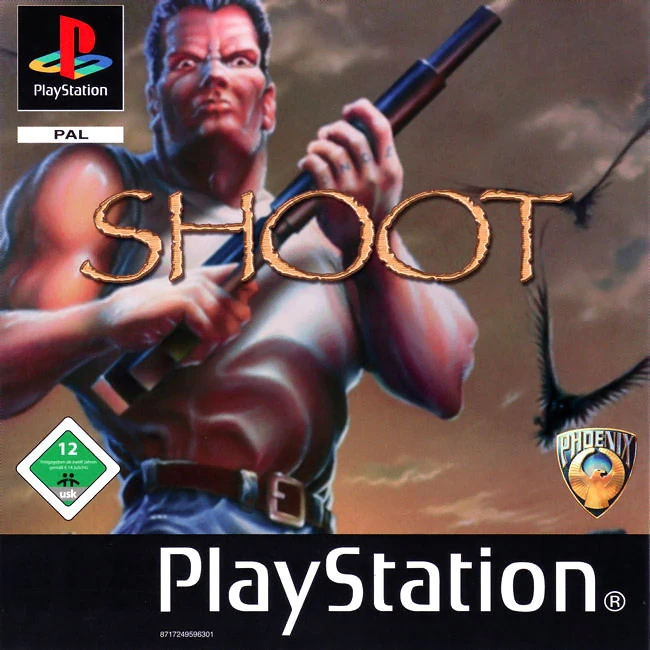
Here’s an interesting thing: Naps and Phoenix did actually rename Silent Iron to War Drones, and re-release it as part of a 7-game slopfest compilation called Shoot, which came out in as late as 2005 for the PS1. That’s a year before the PS3! That box art is way cooler than any of the games included actually are, though.
READ NEXT: 10 Worst N64 Games of All Time
Some of the coverage you find on Cultured Vultures contains affiliate links, which provide us with small commissions based on purchases made from visiting our site.