

The amazing thing about the OG PlayStation is that it means something different to everyone. For some, it was where they played genre-definers like Metal Gear Solid and it changed the way they saw games. For others, it’s where they played weird, experimental, sometimes flawed games like these that may not get the plaudits, but are in a whole other world of their own.
Digimon World
Digimon has long played second fiddle to the Pokemon series, whether it’s because your mum calls them Pokemon anyway or the games are considered broadly better. Maybe that last point isn’t quite as accurate these days, considering every new Switch Pokemon game seems like it was outsourced to your mum, while recent Digimon games are fairly well received, but that’s a whole other story. Literally. The point we’re making is this: nobody is going to forget about Pokemon, while it’s mostly left to the streets to keep the fires burning for the Digimon series. Nowhere is that more true than for Digimon World, which received pretty negative reviews upon launch. The streets still massively love it though.
Admittedly, the story for Digimon World is barebones as all hell, with a danger facing File Island and all the inhabitants having run away before the player character arrives. As a human who’s been transported to File Island, thank god you aren’t called Peter, you need to bring the Digimon back to the town while raising your own Digimon in the process. Here, the game becomes equal parts virtual pet simulator and action RPG, as you need to both feed and play with your steadily evolving Digimon while also taking them out into the field to fight with wild Digimon. At least, you’d guess so. See, I think about 90% of people who played this had no idea what was going on as your little digital guy pooed himself into an early grave. Good, bewildering times.
Psychic Force
Most regular PS1 owners who liked fighting games would have owned the classics: your Tekkens, your Street Fighter Alphas, maybe even a cheeky bit of Tobal or Battle Arena Toshinden as a treat. Real ones were playing Psychic Force, and by real ones, we do mean sickos and nutters who fell in love with the game’s anime aesthetic and novel approach to fighting game combat. Personally, if there’s one street that won’t forget Psychic Force, it’s 1 Vulture Avenue, the fictional address for our non-existent HQ. Psychic Force was one of the first games we remember talking about for the PS1. In that way, it feels like it’s part of the channel’s history.
Set in the far flung future of 2010, Psychic Force follows a cast of characters who’ve been blessed with, you guessed it, psychic powers. Next you’ll say there’s some kind of force looking to do a bit of evil. Wouldn’t that be crazy? The game itself differentiates itself from other fighting games by being a fighting game set in a massive cube. Though the game is 3D, players can move in any direction on a 2D plane, with the goal to basically slam your opponent into the wall as much as possible in order to deal damage. With multiple characters to choose from, special moves and combos to learn for each one and plenty of defensive options too, there’s more to sink your teeth into here than you’d think. You could say it’s “Loaded” with fun stuff.
Loaded
Loaded is one of several PS1 games that made a name for themselves by being edgy enough for you to physically cut yourself on. It’s not that surprising, really, considering the character concepts were developed by artists Les Spink and Greg Staples of 2000AD, which isn’t known for its sunshine and rainbows vibes. Better still, a 12 page novella about the game was written by Garth Ennis of The Boys fame, so if you want to see what dark and edgy looks like before Homelander and Punisher MAX, Loaded is the game for you.
While Loaded certainly isn’t the only game on PS1 that made a name for itself by being soaked in gore and off-colour jokes, Loaded had the virtue of being one of the first. The game launched in December of 1995 in America and felt like a statement piece for what the PS1 could be capable of. Granted, that statement was “look at all the blood and guts”, but the visual effects, particularly the lighting, earned Loaded a lot of credit when the game first launched.
As for the actual gameplay, critics were a lot less kind, considering Loaded is merely nothing more than a sci-fi Gauntlet clone with homicidal maniacs instead of fantasy trope characters. Still, if you want to play as someone who looks like the Joker on a particularly bad day, Loaded offers just that. His name is Fwank, and fwankly, he scares us a bit.
Die Hard Trilogy
The most positively received game so far in this video, Die Hard Trilogy was proof that ambition can sometimes pay off. Instead of just making one film tie-in game with one specific style of gameplay, developers Probe Entertainment decided to make three separate games for each film in the then-Die Hard trilogy. God, to live in a world where those extra Die Hard films don’t exist. Anyway, Die Hard Trilogy really made the most of the variety that each film excels in, offering three complete experiences with their own unique challenges in the process. Sometimes, it’s a choice between quality and quantity, but Die Hard Trilogy is a game that offers both, making it well worth adding to your PS1 library if you haven’t already. Compared to other PS1 games, the prices are pretty decent too.
As mentioned, each film in the Die Hard Trilogy is represented by its own gameplay genre and structure, with the original Die Hard playing as a third person shooter. Each level is a different floor filled with hostages and terrorists for McClane to clear out. Die Hard 2, a more action focused film, takes on the gameplay of an on-rails shooting gallery. Makes sense if you imagine John McClane on that horizontal escalator during the terminal shoot-out, or those conveyor belts in the luggage sorting room. Finally, Die Hard With A Vengeance is actually a racing game, as you’re racing against time to defuse the bombs that Simon has placed all around New York. All three are thrilling and fun to play, making the whole Trilogy a game people won’t forget. Special mention to the sequel to, Viva Las Vegas, which wasn’t as well received as Die Hard Trilogy 1.
One
Another game that reviewed well at the time but has seemingly become an obscure entry into the PS1’s overall library, One doesn’t get the love it deserves at this point. Those who love shoot ‘em ups with a side of platforming will have had One on their radar at least, but compared to the majority of shooters that were released on the PS1, One isn’t quite as remembered. Maybe that’s because it doesn’t have some memorable hook, like how Armageddon had Bruce Willis playing the lead character, or because more traditional shoot ‘em ups like Gradius don’t tend to age as well, but either way, One’s legacy isn’t what it could have been. At least the streets are all about that One life.
One is a linear blaster where players control the most video game ass named character in history, John Cain, who has woken up in an apartment building with no memories, a big gun in place of one of his arms and a barcode at the back of his neck. If that’s not enough of a reason why John Cain needs to find answers urgently, police helicopters have arrived and they’re firing more missiles through the apartment window than an entire naval battleship. John then has to use his new firepower to blast his way through six levels and multiple bosses to find the answers he needs to survive. It’s a pretty simple and repetitive game in all fairness, but if you want some obscure PS1 excitement, you can do a lot worse than One.
Vigilante 8
There’s two trends that allowed for Vigilante 8 to launch on the PS1. The first is the practice of bringing PC games to console, albeit with a completely new name and, sometimes, a new coat of paint. The second is the sheer hype surrounding car combat games in the 90s, started by the likes of Twisted Metal and Carmageddon. Enter Activision, who had already released the game Interstate ‘76 on PC in 1997, a car combat game set in an alternate history where the Oil Crisis of 1973 hadn’t been resolved and police have resorted to authoritarian tactics to maintain the peace. The result: everyone starts strapping machine guns to their cars to become vigilantes.
Because they didn’t have the internal staff to develop a port, Activision hired then fledgling developer Luxoflux to bring Interstate ‘76 for consoles, but due to the console’s limitations, the developers had to downsize the game with smaller maps. This fundamentally changed the core gameplay loop, creating a more action-oriented game that led Luxoflux to ask Activision to turn this into its own thing. Vigilante 8 was born, releasing a year after Interstate ‘76 on PS1, attracting plenty of positive reviews for its easy controls and stellar graphics. Luxoflux released a sequel in 1999 called Vigilante 8: 2nd Offence, also for PS1, which added new characters, maps and modes, and released to more excellent reviews. Unfortunately, the series has been long dormant since a lacklustre Xbox Live Arcade remake, aptly titled Vigilante 8 Arcade, released in 2008, taking elements from both games to create the minus of its parts. But don’t worry, you’ll always be the 1 for me.
Tunnel B1
Is it any wonder that a game like Tunnel B1 was forgotten when it’s got such a vague, nothing name like that? Tunnel B1 could be about anything, from a horror game to some kind of mining simulator. And then you look at the box art and you still have no idea.
It’s a name that gives you a setting at best, and you’re left to pick up the pieces by either playing the game or looking at the blurb on the back of the box. Thankfully for you, the game got ported to Steam a while back, so you’ve got a Steam description to look at instead.
You pilot a heavily armed hovercraft and must speed down tightly packed corridors filled with sentry guns, helicopters and other threats that are planning to bomb you back into the stone age. What makes levels in Tunnel B1 so interesting and difficult is the fact that most of the levels are on a timer, meaning you have to plan your attacks, focus on the correct targets and reach your destination in time without getting murdered. Reviews at the time were the dictionary definition of mixed, with most praising the visuals while criticising the game’s repetitive nature, but there’s a good game here that both looks good while making you feel powerful. If you can get past the crappy name, Tunnel B1 is worth soldiering through.
Small Soldiers
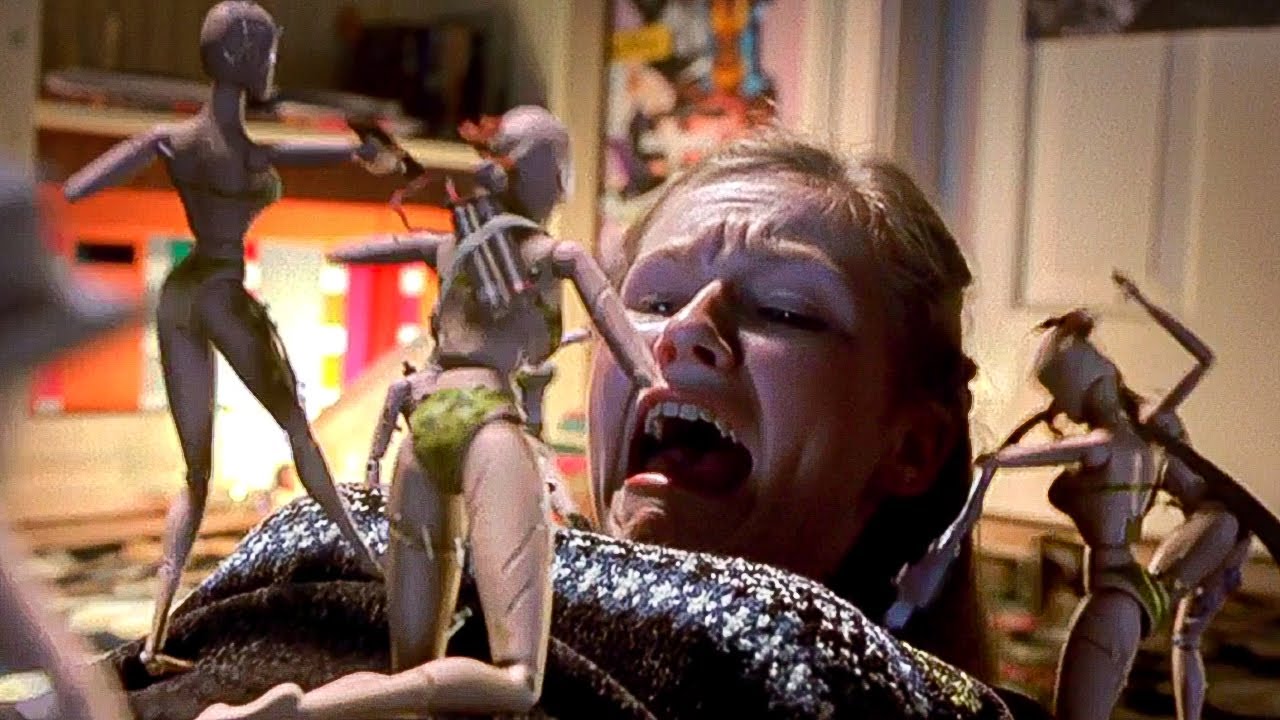
The epitome of a “streets won’t forget” movie, Small Soldiers is a certified B-movie whipper. Based on the premise of “what if Toy Story was a bit mental?”, Small Soldiers introduced the world to the diabolical evil schemes of Chip Hazard and the Commando Elite, along with the peaceful Gorgonites. It also gave the nightmare fuel that was the Gwendy Dolls scene. Never looked at a Barbie the same way again. Like all good films from the 90s, Small Soldiers even got itself a video game tie-in, which makes sense. A film about toys? Let’s make a game for the most popular toy of the modern day: video game consoles. What makes the PS1 version of Small Soldiers interesting though is how it fits into the film’s established fictional lore. Let me explain.
Instead of just retelling the events of the film with young lad Alan Abarnathy defending the Gorgonites against Hazard and his bad boys, Small Soldiers on PS1 is based on the mythology of “Gorgon” itself. It’s essentially the made-up backstory for the toys that’d be used to sell the toys in-universe. In fact, you could almost believe that the game Small Soldiers would exist within the film’s world, marketed to kids who’ve already bought the toys. Maybe that’s too much theorising and analysis for a third person shooter film tie-in, and maybe we’re giving the game’s developers a bit too much credit, but it’s interesting to think about.
The gameplay itself is pretty fun with a really quite chilling atmosphere sometimes. It genuinely scared me as a kid. Let me know what game spooked you that shouldn’t have down in the comments.
Akuji the Heartless
One of the secrets to becoming a “streets won’t forget” game, especially on the PS1, is having the game appear on various magazine demo discs. Many of the biggest and most recognisable games on the PS1 built up thei r groundswell of support just by featuring their game on some kind of demo disc. Those demo discs for both PS1 and even PS2 really shaped the interests of an entire generation, and one game in particular that earned that benefit on PS1 was Akuji The Heartless. Sure, it might not be as big as other Crystal Dynamics games like Legacy of Kain, but those who love Akuji The Heartless really bloody love it. We’ve seen some of you sickos in the comments who gas this game up, so here you go.
An action adventure game with large, free-roaming levels, Akuji The Heartless is about a voodoo priest with plenty of spells and retractable claws finding himself cursed to wander the Underworld after having his heart ripped out on his wedding day. Literally, of course, the bride didn’t just run away from the altar like it’s the newest season of Love Is Blind. No, Akuji’s brother decided he wanted to kidnap that ticker. Players then try to escape from the Underworld to rescue Akuji’s bride and seek revenge against his own brother. With plenty of varied spells to choose from, including the ability to summon demons or possess the bodies of fallen warriors, Akuji The Heartless is the poster child of a streets won’t forget game. Mostly because we think if we do forget it, we’d get hit with a voodoo curse or something. We’re nearly done today, if you Chan believe it.
Jackie Chan Stuntmaster
If Small Soldiers is a film that the streets won’t forget about, Jackie Chan is the movie star that no one will forget. Sure, he might be a bit more mainstream, but the guy arguably brought kung fu and martial arts cinema to a whole new generation in the same way Bruce Lee did. His impact is undeniable and no one will ever forget his name. Also, The Jackie Chan Adventures was the best cartoon going, just saying. While his impact on films and TV is massive, his impact on video games isn’t as massive. The Jackie Chan Adventures had a few tie-ins which were decent, the GBA one more so, but Chan’s other games aren’t quite as good. We’re looking at you, arcade release The Kung-Fu Master Jackie Chan, which was just a poor man’s Mortal Kombat clone sold off the back of Chan’s name.
One Jackie Chan game that beat ‘em up lovers on PS1 will never forget though is Jackie Chan Stuntmaster. A 3D platforming beat ‘em up, players control Jackie as he tries to rescue his grandad from a group of villains. Cue Jackie battering his way through hordes of goons across New York City in 15 levels. What perhaps makes Jackie Chan Stuntmaster one of the most interesting releases, both on PS1 and from the martial arts legend, is how involved Jackie was in the process of the game’s development. Jackie motion captured all the moves and attacks, meaning players were, in a manner of speaking, controlling Jackie Chan. Reviews aren’t exactly glowing, but there’s been worse beat ‘em ups in history, and if you tell people Jackie Chan is involved, most people would be convinced to give it a go. The power of Chan, man.
READ NEXT: Indie Games That’ll Be Huge in 2026
Some of the coverage you find on Cultured Vultures contains affiliate links, which provide us with small commissions based on purchases made from visiting our site.