



Everyone loves a good “two rivals have to work together to overcome a common enemy and also one of them might sort of be a ghost” trope, don’t they? It’s a classic. And for those who love the classic games of yesteryear, where the main trope was the destruction of self-belief, Ninja Gaiden: Ragebound will definitely scratch an itch.
To be fair, Ragebound is a good bit more forgiving than its 2D forefathers from the 8-bit era. While challenging, it never feels particularly unfair, and you’ll probably be able to overcome everything before the ache really sets in on your left arm. It’s also just generally very fun, too.
Pitched as a untold side story in the Ninja Gaiden canon, Ragebound sees you playing as Kenji Mozu, a protege of series lead Ryu Hayabusa, who winds up in a spot of bother after being tricked by demons (bloody demons). He’s forced to team up with Kumori of the Black Spider Clan to basically become the side-scrolling version of Talion and Celembrimbor. Kenji does all the slashing, while Kumori uses her narratively convenient spectral form to chuck kunai and unleash super powerful moves.
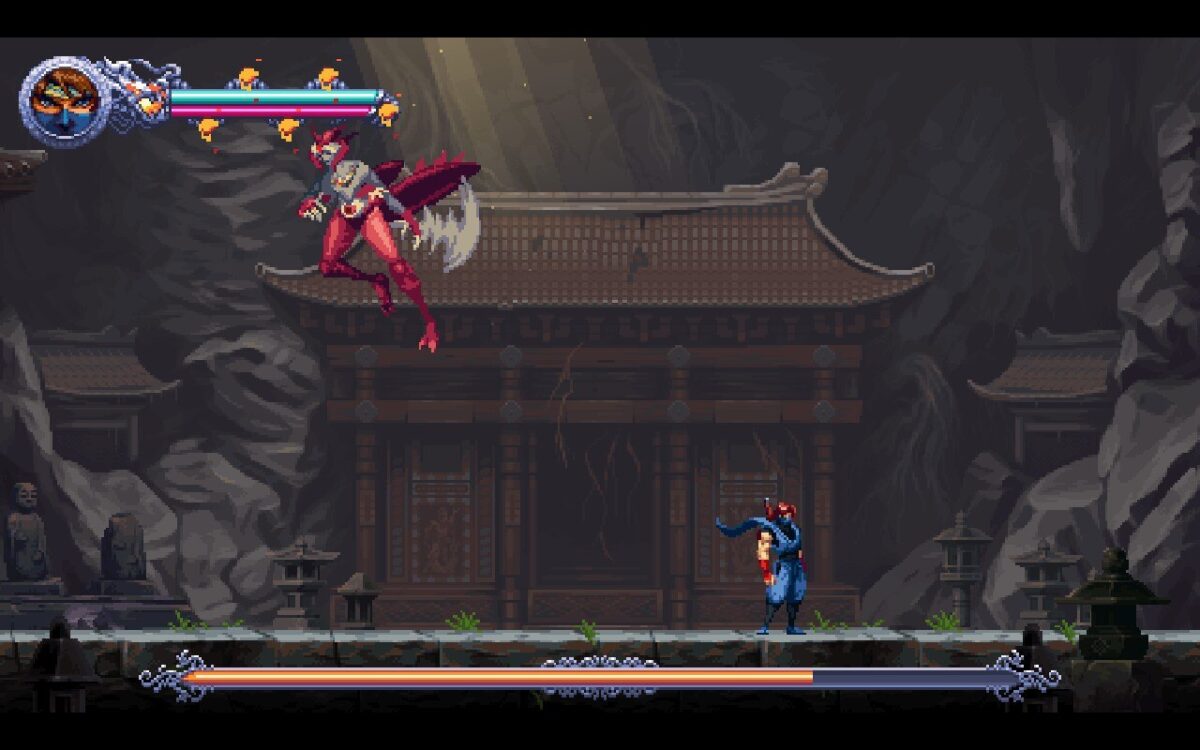
You’ll be slicing, rolling, and jumping your way across almost 20 beautifully detailed and pretty varied levels. Ragebound isn’t afraid to get a bit weird with the format. Playing as a ninja on a speedboat trying to avoid a helicopter piloted by demons feels pretty authentic to the 8-bit feel that The Game Kitchen were trying to replicate. There’s also a bunch of secret areas to find, as well as completely optional side missions for the truly devoted.
Generally speaking, combat is pretty intuitive and very satisfying once you get into the flow of it. Most enemies die after one attack, but Ragebound’s Hypercharge mechanic comes in clutch against slightly sturdier enemies. If you kill an enemy with a specific aura around them, you’ll then become empowered to kill every enemy in one hit, but you have to be quick before the effect wears off. There are even distinct power-ups for melee and ranged attacks, so there’s a lot of juggling going on.
It gives Ragebound this kind of kinetic snowball feel, where you sequentially line up your attacks in order to clear screens most effectively. For example: enemies D and E take multiple hits, so you should kill the aura-farming A and B enemies while making sure to not hit enemy C with your Hypercharge, or else you’ll waste it.
The system actually reminds me of something like Hotline Miami, where you had to figure out the quickest and most efficient “lines” through repetition in order to survive. It’s a rewarding loop that might thwart those that aren’t in the mood to basically learn through failure, but that’s retro gaming right there.

I personally didn’t find the levels to generally be too tough, as checkpoints are plenty forgiving and there are health pick-ups everywhere. Invincibility frames are kind, and you can basically double jump off of enemies to give yourself some breathing space. Platforming feels precise, though maybe a bit finicky when it comes to grabbing onto ceilings. But the bosses definitely took things up one or fifteen notches in terms of difficulty.
These fights feel much more rigid in terms of how you approach them, as they’re pattern-based but usually with one or two variations in patterns each time, so you can never be entirely sure what’s coming next. And then when you’re halfway through the health bar, most bosses step up to 1.5x speed and the challenge rises again.
None of them are unbeatable, but most of the fights can drag on for quite a while as you chip away at their health bars over and over, so you may have have to do some wrist exercises in between repeat attempts. Funnily enough, the first “proper” boss fight was by far and away the most taxing for me, as I had to rewire my brain from the usual gameplay rhythm of constantly pushing forward. I’m someone who’s been learning Welsh for months now and can only just about ask if your toilet paper is feeling happy, so it took me a long old while to learn the nineteen different sequential attacks without dying. I think I added about an hour to my eight hours of playtime simply from deep breathing. The bosses from then on weren’t pushovers, but once I matched Ragebound’s tempo, my grip on the Steam Deck got a lot looser.
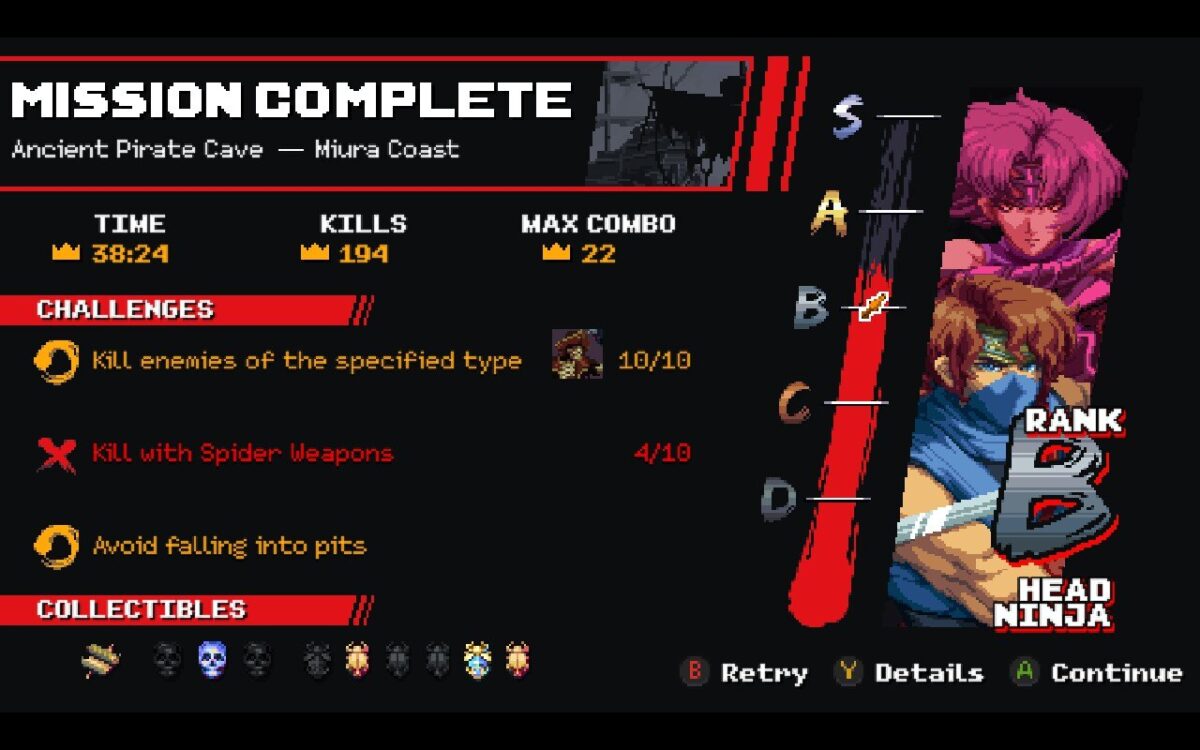
One thing that could’ve helped (and not just in terms of beating a boss) might’ve been the ability to swap out upgrades at a checkpoint to really play around with your build and come at a challenge from a different angle. Upgrades are unlocked by finding scarabs that are usually dotted around in the levels or in sometimes brutal platforming sections where you take full control of Kumori. Unfortunately, you can equip just two at a time and only change them between levels, which feels like a missed opportunity. I had 35 spare scarabs by the end of my playthrough, as either I didn’t want to switch up what was working for me or later upgrades simply didn’t seem as useful.
But I get the sense that diehards will get way more out of the system than me, particularly with the unlockable hard mode and challenges to complete. Ragebound is probably one of the easier Ninja Gaiden games out there, but those who hate themselves a little will still likely find a lot of challenge here if they go looking for it.
You don’t have to be a series diehard to get something out of this one, though. With gorgeous visuals, engaging difficulty, and a “just one more go” loop that’s hard to resist, the resurrection of Ninja Gaiden is off to a very promising start.
A Steam key was provided by PR for the purposes of this review.
Some of the coverage you find on Cultured Vultures contains affiliate links, which provide us with small commissions based on purchases made from visiting our site.