

Modern online gaming: press two buttons and make Snoop Dogg dance with Goku. But it wasn’t always this accessible, especially on consoles. Relatively few people played the PS2 online, but those lucky few had some incredible experiences back in the early 2000s. When it all worked, of course. But for every SOCOM and Monster Hunter, you had these forgotten online PS2 games. Let me know what your favourite PS2 online game was down below, but don’t drown your sorrows.
Gauntlet: Seven Sorrows
Given how much online gaming has grown over the past two decades, it’s shocking that Gauntlet, the original arcade co-op RPG, hasn’t become a more mainstream franchise in some capacity. Dungeon crawling with your mates is some of the most fun you can have playing games, but there hasn’t been a new game in the Gauntlet franchise in 11 years. In fact, the last game was developed by the Helldivers 2 developers Arrowhead Studios, who you could say know a thing or two about co-op gaming. It feels like the Gauntlet series has been passed by these days, with other franchises cherry picking parts of Gauntlet to augment their own work, but that doesn’t mean Gauntlet wasn’t at the cutting edge once upon a time.
Before Arrowhead’s take on the series, Midway developed and published Gauntlet: Seven Sorrows, which included the usual Gauntlet trapping of the four original heroes (that’s yet wizard, yer elf, yer warrior and yer valkyrie) delving into dungeons under the promise of loot and glory. There’s a wider plot about the four heroes being betrayed by an emperor, who in turn was betrayed by their advisors and subsequently stole the heroes’ immortality, becoming monsters as a result, but it’s still all about loot either way.
What made Gauntlet: Seven Sorrows special though is that that full game is playable in either single player, local co-op or online play, which feels like a standard for most games these days, but for 2005? It’s incredibly forward thinking and will always be burned into our memories.
Crash ‘n’ Burn
You might not have heard of Crash ‘n’ Burn, but you’ll definitely have heard of the developer’s output. While they were known as Climax Racing back in 2004, the studio would rebrand as Black Rock Studio and release one of the best seventh generation racing games of all time: Split/Second. The fact that Disney shut the studio down a year later, kiboshing a Split/Second sequel in the process, is practically a crime and Disney should give us their Avatar money to say sorry, but we’re getting off topic.
The studio might have ended with a brilliant racing game, but Crash ‘n’ Burn is not on the same level as Split/Second unfortunately. What it is, however, is an ambitious attempt at online-focused destruction derby racing years before games like Wreckfest.
On the surface, Crash ‘n’ Burn is a fairly generic arcade racing game, albeit with a destruction derby twist. Races and events take place across iconic locations in America, with a variety of event types to compete in to give players more than just bog standard racing. Sure, that is there, but there’s also team racing and a host of battle modes like Last Man Standing, Running Man, Bomb Tag and Assassination. What separates Crash ‘n’ Burn from the other arcade racing game competition on PS2, especially those that offered online play, is that Crash ‘n’ Burn supported up to sixteen players per race, which was rather ambitious for a PS2 racing game at that time. Compare that to Burnout 3, which only offered support for eight players, and there’s no denying that Crash ‘n’ Burn shot for the moon.
As for whether they stuck the landing, well…I guess you could say they derailed and immolated. Don’t steel that joke please.
S.L.A.I.: Steel Lancer Arena International
PS2 gamers, or just anyone gaming during that generation, were absolutely munching down on their fill of mech games like a family of beavers at a pirate convention. Armored Core, Robotech: Battlecry, Front Mission, Robot Alchemic Drive, Ring of Red; there were so many different kinds of mech games with different genres of play, meaning everyone who loves big robots fighting each other could have their needs met. If you just want to build mechs and compete against other pilots though, S.L.A.I.: Steel Lancer Arena International is the game you need, though don’t be surprised if you think you’re playing online while you’re playing the solo campaign. The whole game is modelled like some kind of Ready Player One cyberspace, only for you to control robots in the real world. It just also has an online mode too.
Set in the 2070s, traditionally a not very chill period in gaming, players control a pilot known as a Wire-Head, He pilots mech-like robots called Scoot Vehicles, who compete in arenas across the world. As a newcomer, you have to rise through the individual ranks of the world’s seven arenas, defeating the best Wire-Heads to cement yourself as the greatest, customising your own SV along the way with new weapons and parts. Oh, and there’s a serial killer to hunt down too. As for the online mode, S.L.A.I. took its own cue from the single-player, with leaderboard rankings and, crucially, the ability to form your own clans. A modern version of this would be pretty interesting, but I promise not to go on about it forever.
Everquest Online Adventures
MMOs were few and far between on the PS2, but there were a few of them. Despite SEGA proving that MMOs could work on consoles, thanks to Phantasy Star Online on Dreamcast, it took forever for developers to actually give plenty of proper MMO options for console players. Still, PS2 players had Final Fantasy XI, Front Mission: Online and Phantasy Star Universe to choose from. Pre-World of Warcraft though, there was another big player in the MMO space that seems to have been forgotten about: Everquest.
While Everquest appealed to traditional console gamers with the Champions of Norrath games, Sony developed a console specific version of Everquest titled Everquest Online Adventures. No PC players to tell you you’re not raiding correctly or whatever MMO players talk about. Leroy Jenkins, and so on.
Inspired in part by Square Enix’s attempt at console MMOs with Final Fantasy XI, Sony wanted to develop an MMO on PS2 that didn’t need a hard drive to require play. The actual game itself offered plenty for MMO fans to dig their teeth into, with 15 playable classes and 10 races, along with hundreds of quests for players to work together and complete. Or, engage in PVP if they prefer too.
Sony would release an expansion pack about eight months after the game’s original release, Frontiers, which offered another race and class along with more quests and items. Amazingly, Everquest Online Adventures would stay online until 2012, but there’s a wave of modern players who aren’t done with Everquest yet, creating an unofficial server that lets players relive 2003 in their own way. Ten out of ten to that community.
Full Spectrum Warrior: Ten Hammers
There’s something arguably “a bit cheeky” about how the military sometimes markets to gamers. You could see this when the US military commissioned Full Spectrum Warrior, a video game designed to be a military training tool. Sorry, that got a bit heavy, here’s Danny DeVito with loads of hair.
Considering Pandemic Studios had already developed Full Spectrum Warrior for the US Army, they decided that they should double dip and release the game commercially too, releasing the game on PS2 in 2005, about a year after the game already launched on PC and the original Xbox. The result was a military shooter unlike others on the market at the time.
Instead of being about me defending my obsession with Metal Gear Solid 2, Full Spectrum Warrior is a squad-based shooter which gives players command over two fireteams, sometimes three during some missions in the game. Essentially, you need to command the squads efficiently, giving orders to lay down suppressing fire to advance and clear objects. With one bullet being enough to end everything, Full Spectrum Warrior is an undeniably hardcore shooter, but the first game didn’t offer online support on PS2.
Enter the uber forgotten sequel, Ten Hammers, which offered co-op and competitive multiplayer for up to four players on PS2. I don’t know anyone who played this, probably cos it came out in 2006. Sure, Xbox Live had a slightly better experience, but still, this is the textbook example of a forgotten PS2 online game. Be honest, who was playing this over SOCOM, you know? 1 guy? 8 dudes? 7 bros?
187 Ride Or Die
By the time that 2005 rolled around, the car combat genre bubble had basically burst. The Twisted Metal hype was over with and it didn’t seem like anything new was really poised to take that space. Ubisoft decided they would have a go. While car combat games in the past were typically aimed towards edgy teenage lads, Ubisoft’s 187 Ride Or Die added a more, well, not to put too fine a point on it, “gangsta” flavour. Instead of clowns with flaming heads and miniguns, it’s gangbangers in lowriders firing uzis from the passenger seat. Reviews were, naturally, caustic at the idea, but also at the execution, considering the gameplay was repetitive and the car handling wasn’t great.
There’s a story mode here, with players controlling Buck who tries to rise through the ranks of the South Central criminal underworld. Apparently, you do that by holding street races and riddling your opponents full of bullet holes. Hard to have any competition when the morgue is piling up with dead bodies, let’s be honest. Anyway, while there’s a full co-op mode that allows players to treat the game like Mario Kart: Double Dash, with one player driving and one shooting, it also featured a full online mode. There were your standard races, along with a variety of destruction focused modes too, so if you wanted something of a different flavour after playing Twisted Metal: Black, 187 Ride Or Die was an option.
It wasn’t a good one, but it was an option.
Spy Vs. Spy
It’s not uncommon to see games based on comic books, but a specific small comic strip? That’s a bit more strange, making 1984’s Spy Vs Spy a bit of a trailblazer in a certain respect. Based on the Mad magazine strip of the same name, Spy Vs Spy for the Commodore sees two almost identical spies, one black and one white, competing to steal some important documents and escape an embassy. Naturally, the two spies can interfere with each other, either in direct combat or by setting a few Looney Tunes style traps to catch the other off-guard. There were a couple of direct sequels and ports for other platforms at the time, but for our purposes, we need to take a look at the PS2 remake that launched in 2005.
Developed by Vicious Cycle, Spy Vs Spy for the PS2 retained that same competition between the black and white Spy, but instead of being a side scrolling adventure, this version was a first person shooter. The objective was still the same, of trying to collect items on a map and escaping before the other Spy, but they also threw in a Story mode and a few more traditional multiplayer modes for up to four players. Spy Vs Spy somehow managed to earn almost as reviews as 187 Ride Or Die, which should give you some idea of why this shooter happens to be one of the most forgotten online PS2 games ever made. Besides, we can’t condone a game that really endorses such… tribalism.
Tribes: Aerial Assault
Perhaps the truest definition of a movement shooter in all of gaming, Tribes has been the sleeper hit of the PC shooter community for getting close to three decades at this point. Sure, the series might be in the lowest point it’s ever been, thanks to it being taken over by Hi-Rez Studios, before being sold to their subsidiary turned fully indie studio Prophecy Games, followed by the botched Early Access release of Tribes 3: Rivals in 2024. At this point, it’s basically abandonware. Anyway, Tribes is often considered to be the one multiplayer shooter that’s never really made the transition from PC to consoles, but that’s not entirely true, as the series was brought to PS2 in North America in 2002.
Developed by Inevitable Entertainment, who would later become Midway Studios Austin, Tribes: Aerial Assault is essentially the multiplayer experience that PC players had become used to for a few years already, only condensed down for the PS2. All the usual multiplayer modes were there for players to enjoy, like Deathmatch, Team Deathmatch, Capture The Flag, an objective-based mode called Capture And Hold, and a free-for-all survival mode called Hunter.
What separates Tribes from all other multiplayer shooters though is the jetpack, allowing you way more mobility than you’d typically see in any other FPS. If you feel like playing Aerial Assault, Hi-Rez did release the game as freeware on the Tribes website, though the website is now defunct. Either way, it was free, so don’t feel bad for emulating it, matey.
Hardware: Online Arena
Depending on where you look, you might think that this was the first ever online game made for the PS2. In reality, there had been plenty of online enabled games released on the PS2 before November 2003’s Hardware: Online Arena, with Tony Hawk’s Pro Skater 3 being considered by many to be the first ever PS2 online game. Online play in the early days on PS2 was kind of like the Wild West, with Sony giving developers the option to explore online services of their own. Imagine playing a PlayStation or Xbox console these days with some kind of centralised service governing it all. Yeah, it’s wild.
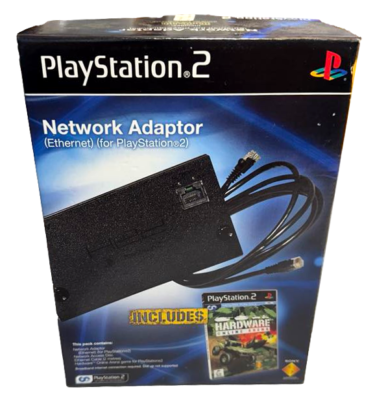
Instead, Hardware released in Europe (and Europe only) in 2003 alongside the launch of Central Station, a Europe-only online service owned and operated by Sony. This service included the ability to create Friends Lists and see updates on PlayStation related news, making it a precursor to PSN of sorts. Later on, Hardware: Online Arena would even be bundled with the PS2 Network Adapter, making it a pretty popular release, but it would be ultimately forgotten before too long. As for the game itself, Hardware was yet another example of a car combat game, with plenty of weapons, vehicles and modes for players to enjoy.
It even received a PSP follow-up, Fired Up, which actually featured a single-player campaign.
Dirge of Cerberus: Final Fantasy VII
The western release of Dirge of Cerberus was simply just the single player experience, but Japan’s release had a full online multiplayer mode, complete with its own story, missions and characters. Unfortunately for anyone in the West who wanted to experience this for themselves, Square Enix made the decision to remove the multiplayer mode from the game in favour of making a purely single player experience.
The mode itself was hosted for just a few months in 2006, supported by Square’s own PlayOnline multiplayer gaming service. The mode saw players controlling a Deepground soldier trying to climb the ranks, with the player competing in various modes like Deathmatch, Capture The Flag and others. Unfortunately, most of the data for the mode was housed on Square’s own servers, meaning it’s been next to impossible to revisit this mode in the modern day, though there have been attempts to archive as much information about the mode as possible. We really don’t even have much footage of its existence.
To Square’s credit, they did retrofit some online content into unlockable bonus missions for the Western release, and released the mode’s cutscenes on special edition discs, but Dirge of Cerberus’ multiplayer mode serves as a very early example of an attempt to marry story and multiplayer, which always went well.
READ NEXT: Streets Won’t Forget PS1 Games
Some of the coverage you find on Cultured Vultures contains affiliate links, which provide us with small commissions based on purchases made from visiting our site.

:max_bytes(150000):strip_icc():focal(742x0:744x2)/danny-devito-senior-1962-111522-1-2000-3c74b363389c4bcb86de3cffd43b2cf1.jpg)