
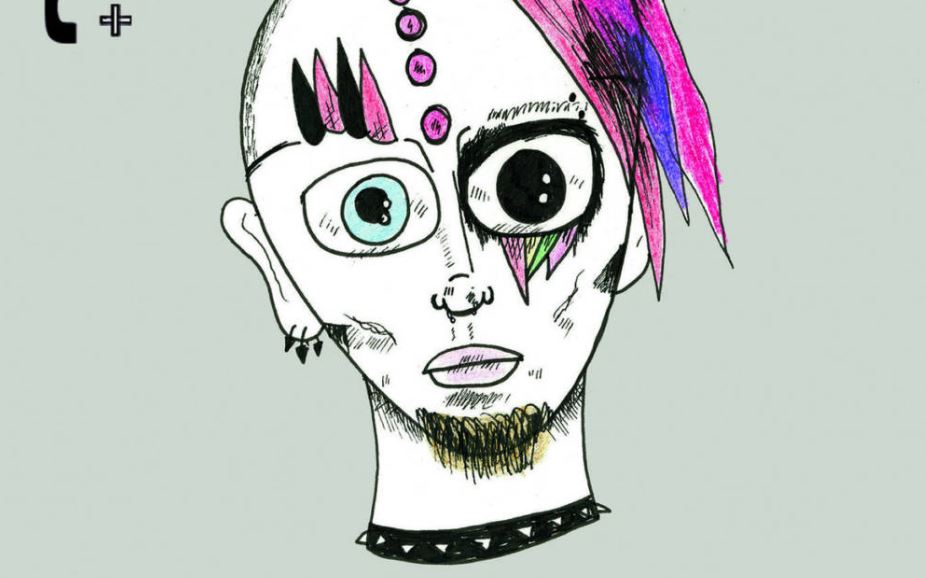
I’m honestly not sure where I first heard of Justin Symbol, but it has to have something to do with Facebook in 2012, and the group of people that gathered online around the late Daisy Berkowitz. At the time, he was in a band called Nursing Home. They’d just released an EP of pop industrial tunes with titles like “Emerald City” and “Car Crash Life.” I’ve always been a fan of the less experimental industrial music that came out of the 1990’s, and the Nursing Home EP really reminded me of that stuff.
We’ve kept in touch off and on over the years, and I’ve occasionally threatened to interview him for various web magazines, but it always ended up getting put off. Well, until now, of course. I’ll be meeting him in a few days for a Scott Putesky memorial show in Brooklyn, where he will be playing some tunes, along with JP Marin, and MaTT De Vlieger, who are hosting the event alongside writer and journalist Gina Tron. Today, though, we had a conversation over the phone.
Could you tell us a little about your background, how you got started with music in the first place?
I started doing music on drum machines, using Fruity Loops, doing electronic / noise / industrial stuff. And then while I was up at school at Syracuse University, that led to me forming a band. From there, I just always had a band. It kind of culminated with me here in New York, making music and starting to tour.
Are you from the city?
I’m from the Tri-State area. I never lived in the city until I had graduated from Syracuse University and then came here to work as a video editor and to pursue music.
You’re a solo artist now, though you’ve been in bands before. What’s the difference between working in a band dynamic and your solo stuff?
They both have positives and they both have challenges. I think in a band one of the things that’s really good is when you feel kind of worn out or you’re just sort of out of ideas, there’s someone else to carry the torch a little bit. Sometimes writing music in a band means the music can come out feeling a little more organic. But the advantage of a solo artist is that I like to switch styles and I have ideas that doesn’t fit a mold. And as a solo artist, I’m able to explore a lot of different directions within the same project. The Fuckboi EP was very much influenced by hip hop r & b and dance music, which was different from what people knew me for. In a band people are a bit more rigid at times.
So the Fuckboi album is a new direction. I think in a lot of ways it returns to the playfulness that was there in [Symbol’s former band] Nursing Home. What made you want to go in that direction?
What happened was, I was touring with a band called The God Bombs, and it was very much a rock / metal kind of direction. We had an album called GΩ D H E A D that we’d been working on for a very long time. In the meantime, I’d become more and more interested in trap music, hip-hop, and rediscovered my love of drum machines. I rediscovered my love of electronic music and hip-hop and I started rapping a little bit, breaking through to a new style of wordplay and lyricism. I found it really liberating, and I think it became an avenue for me to be really honest and personal. Things just got rough with the band. We were on tour, and we were touring too much. You know how it is when you’re on the road with people. It just got very tense, so it was nice to be able to walk away from that and do some things fresh.
It all came together around the romance theme. Sort of like romance gone wrong, I guess you could say. We had the song Fuckboi that was originally going to be on the GΩ D H E A D album and then I totally reinvented it for this EP and then kind of based everything around that.
The whole thing came together in two months, so it’s very much a snapshot of where I was at mentally and musically after touring with the God Bombs and that thing blowing up. I just really threw myself into this new thing, and I’m excited to continue this new direction.
I thought you had some really important things to say, too, especially on the Fuckboi track. You really take aim at misogyny, toxic masculinity, vapid elements in entertainment. What made you want to tackle these kinds of issues?
Everything on that EP is completely autobiographical. I try to never take myself too seriously, so for me, it was looking in the mirror and calling myself out. I was new to the whole rockstar lifestyle, and there were a lot of things that happened from that. It was just something that I was inspired to talk about in a very honest way. On one hand, it was sort of dark, but on the other it’s comical. So I try to look at it from all the different perspectives, and talk about what I’m going through.
Oh, wow. I didn’t realize that the character that’s referenced throughout the song was actually you. That’s pretty cool you can open up yourself like that and really examine yourself.
Yeah, and it’s an ongoing thing. I’m in this new relationship now with a girl that I really love, but I was struggling with infidelity, which is still something that I’m dealing with personally, and actually taking actions to try to better myself. In a way, I think it’s the next journey for me. Since I got sober halfway through V Ω I D H E A D, and had kind of a spiritual awakening there, wanting to get clean from drugs and alcohol, and I think now sex is the next frontier for me, with bettering myself.
You got sober after travelling to Israel, right?
Yes.
What was that like?
It changed everything for me. I was barely allowed in. My dad is Jewish, not my mom, so I’m not technically considered a Jew by their standards. However, for whatever reason, they accepted me. I went there at a period where I was very much aware that I couldn’t control my drinking. Once I had one drink, it would spiral and I would behave in very unpredictable, antisocial ways. So I went there with that hanging over my head, thinking I’m going to scare everyone away, something’s going to happen, I’m going to get arrested. And [laughs] I almost did get arrested there for attempting to steal liquor from a gas station.
Overall, I found that people really accepted me, and it changed my whole perspective. It made me feel like, holy shit, I’m actually a worthwhile human being. And if I could just get this drugs and alcohol problem out of my life so that I stop behaving like a monster, then I won’t be a monster. It had gotten to the point where I was so used to being fucked up and behaving in crazy ways, and associating with individuals who were in the same dark place, that I just thought I was beyond hope. And that trip really allowed me to see myself in a new light and change for the better.
That’s awesome. I’ve been sober myself for about a year and a half. Is it hard being around booze when you’re touring?
I don’t think so. It’s hard for me to be around individuals who are abusing drugs and alcohol. It reminds me of myself, sometimes in a good way, sometimes in a bad way, and I feel a little bit nostalgic at times, but in general I don’t really think about it. I’ve been around it since I got sober, because it happened halfway through the creation of V Ω I D H E A D. I still had to finish the record so I took a month off or two months off and dove right back in. I had to learn pretty early on to not allow what other people are doing to affect my mental health.
Do you think your getting sober has something to do with your more playful musical style on this new album?
Maybe. I think it’s dark in a different way, which may at first seem more playful. But I think it’s deeply dark in a new way. With V Ω I D H E A D I was really suicidal and kind of at the bottom. This is more sex-driven, not so much suicidal darkness. It’s more about God and less Armageddon.
The late Daisy Berkowitz was on V Ω I D H E A D, on three tracks. What was that like?
Daisy was a mentor, a friend, a collaborator. He was really the first pro musician that took me seriously. There was a producer named Pause who introduced us. And we just hit it off. He was never pretentious, he was very welcoming to me. He didn’t even charge me to play on those songs. He just did it because he liked the music.
We went to concerts together. Once I asked him for some business advice, because I was curious how the Spooky Kids business formula worked. And he met me for dinner and told me everything I wanted to know. I’ve never had that kind of treatment from a professional musician since then.
You were going to be the singer on his Daisy Kids album.
I am the singer on it. [The album] is technically released on Spotify.
I’ve listened to the album, but it’s still not totally —
It’s unfinished.
I should clarify: He sang on it, too. It was pretty much 50/50. A lot of it was just drunken jams. It was back when I was still drinking and I was very drunk [laughs]. And we just did something on the fly in the hotel room, and the producer recorded us. We always intended on reconvening and cleaning up those songs and re-doing them. And then that somehow ended up getting released by a label. The whole thing was just very bizarre, honestly.
What’s your level of involvement in your music videos?
Very high. I always act as an executive producer, so I’m in charge of assembling the team that I want and coming up with the overall vision. Then I find the people that can best bring that to life. And that’s sort of like an Easter egg hunt, looking through my contacts and figuring out who’s good at what, and who can I tap for this and that, and that’s one of the advantages of living in New York. There’s so much talent here.
Are you doing a tour for the Fuckboi album?
We were doing a tour with Mushroomhead, but that fell apart because of their booking agent. I’m actually preparing more videos, to be honest. I just released a video for the song “Warlock,” and I’m in the process of filming a music video for the song “Kiss.” I plan to tour in the spring, but nothing as of yet.
What are your future plans?
I’m working on a follow up record right now. If I had to explain the style, I’d say it’s a more punk rock version of the sound I had on V Ω I D H E A D, meets the kind of industrial / hip-hop fusion that occurs on Fuckboi.
Some of the coverage you find on Cultured Vultures contains affiliate links, which provide us with small commissions based on purchases made from visiting our site.