


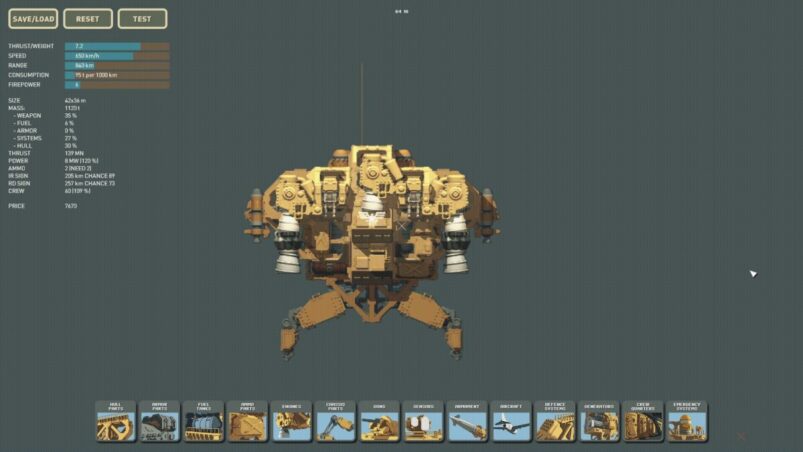
Ship building is quite the enigma in HighFleet as the game doesn’t do a good job of explaining what each part does and how it fits into the overall design. To help aspiring shipwrights lose themselves in endless hours of construction and engineering, we’ve put together a handy guide covering the major pieces of ship building in HighFleet.
Here are the main elements of ship design in HighFleet:
– Hull Components
– Vitals
– Miscellaneous
– Testing
When clicking on new parts in the ship builder mode, the game will highlight viable locations for the selected component. Don’t forget that many ship parts can be rotated with the R key, which can give additional options for fitting pieces together.
Also, be wary that the ship building system can be overly responsive when switching parts out, so be sure to double check (if not replace) that all components fit and don’t have a flashing alert symbol. To add a component design, simply hover the mouse over one of the labeled tabs on the bottom of the screen and click once to add the piece to the designer.
Hull Components
All ships will be composed of hollow hull components where all vital and miscellaneous equipment will go. Players can opt for the cheaper yellow-tinted standard hull components or the far more expensive grey-tinted reinforced hull parts, the difference being greater overall durability.
All hull components come in three sizes: small, medium, and large. Small hull components are roughly half (or less) in size than medium and will usually be able to fit small or tiny parts without issue, such as fire extinguishers and escape pods, respectively.
Medium components will probably be the most common type of hull component on any ship due to their overall flexibility. These parts will be able to harbor the majority of all vital and miscellaneous elements of any ship, including weapons and engines.
Large components are roughly quadruple the size of medium components and are most useful when designing large ships, as it’s much harder to be modular and granular with positioning. These components can handle massive engines, heavy artillery, and cruise missiles or be utilized to hold smaller ship parts if the situation calls for it.
Vitals
No matter what ship a player chooses to design, every vessel will need its vital parts. The bridge is the command center and pilot’s seat of the ship and consequently auto-spawns as the first available component for players to build off of. The vital part cannot be modified in any way and is classified as a medium component.
Fuel tanks directly determine the ship’s effective strategic range on the map. These come in both small and medium varieties. A cool visual feature of ship design is that if multiple medium fuel tanks are placed together they will tesselate to form one giant fuel tank (they will also act as one if damaged in combat).
Ammo is the least vital of the crucial ship parts, but since most ships will want a weapon of some sort, these auto-loaders should be an auto-include for almost any design. Ammo auto-loaders come in small and medium sizes with every weapon requiring its own loader to function.
Engines are what define the ship’s speed, thrust-to-weight ratio, and overall maneuverability. Thrusters and main drives are the two varieties of engine, the former helping with direction change and stability, while the latter directly affects velocity. While both types have medium-sized variants, large engines can only be found with main drives for the particular heavy ships and bulky ships.
The chassis component is simply the ship’s landing gear. They won’t be needed in combat, but are critical for the very common landing minigames and will help cushion ships if they make a hard landing. Most landing gear need at least a medium hull component to connect with.
Generators answer for the internal functioning of all ship parts. For a ship’s weapons, engines, countermeasures, and sensors to work, players must take care to include enough power generation for the ship to stay flying. These come in both small and medium varieties.
Very similar to power generators, crew quarters provide the manpower to operate all of the vessel’s many systems. Depending on how much damage the ship is expected to take it might be wise to include additional crew over the baseline as loss of crew can mean systems not functioning properly or shutting off altogether. Generators also come in either small or medium sizes.
The last vital components are the emergency systems, specifically the fire extinguisher and escape pod. The extinguisher is needed to put out fires on engines in battle to keep them running, while escape pods help save a portion of the crew if the ship is clearly not going to make it. The former only comes in small sizes, and the latter is tiny, allowing it to fill in useless space.
Miscellaneous
Vital components don’t only make sure that the ship airship stays afloat, but also help feed and support the various miscellaneous systems that ultimately define the ship’s role. Armor is the simplest of these components as it adds additional resilience and durability to the ship, while putting extra strain on its engines, making it slower and less maneuverable. Not every ship needs armor, but typically larger ships will need additional protection to make up for their overall worse speed and agility.
Projectile weapons are the primary offensive tools of any ship and all, except the highest calibre artillery, come as medium components. These parts will answer for most of a ship’s battle potential. Projective weapons can range from small calibre rapid fire machine guns, all the way to rocket launchers and single shot massive cannons.
To give ships a strategic reconnaissance role, it may be necessary to fit sensor parts. Such components come as outer hull attachments and won’t fit inside the ship, making them somewhat vulnerable to being shot off or damaged in combat. There’s a wide variety of sensors and players are encouraged to experiment to find the right balance of price, type of detection, and range to suit their needs.
Heavy ordnance can also be classified as expendable weapons, usually various types of bombs and missiles. The trick with using these tools is that they all need easy access to launch without hitting their own ship in the process, meaning such weapons will need purposefully-designed internal weapon bays or simply attached to the outer hull. In regard to size, anti-air missiles are tiny, anti-ship missiles are small, and cruise missiles are large (likely needing several connected large hull components).
Aircraft are a specialized type of strategic weapon used for reconnaissance and long-range interception. For a ship to equip these craft it first needs to be fitted with several external horizontal landing pad components that can house aircraft. Such a landing pad will likely make the ship unmaneuverable and a bulky target, making it suboptimal for tactical combat.
Defensive systems can include active and passive countermeasure systems, such as flares, and reactive shells respectively. Flares will help mess with incoming missile tracking, while reactive shells help ships block heavy artillery shells. The advantage of these parts is that they’re classified as tiny, making it quite easy to fit them on even a cramped ship.
Testing
Though not a mandatory element of ship design, HighFleet includes a test mode for players to benchmark their designs in a quick skirmish against a number of enemies. It comes highly recommended for players to use the testing mode (found at the top of the screen in the ship builder mode) to observe their design’s performance and then fine tune it. Players will have a technical readout of thrust, speed, and the like while they build their ship, but numbers are certainly no substitute for physically seeing and feeling a ship’s capabilities in action.
The ship builder in HighFleet just asks for players to sink hundreds of hours coming up with their own creative designs, experimenting with different roles and supplementing their fleet in the campaign. With this guide equipped, players can now easily focus more on building the airships of their dreams and perfect their mighty war engines.
READ NEXT: HighFleet Ship Roles Guide: Nuclear Missile Carrier, Early Warning & More
Some of the coverage you find on Cultured Vultures contains affiliate links, which provide us with small commissions based on purchases made from visiting our site.