

Despite being known as a more family friendly company, Nintendo can get quite serious sometimes…even also outside of the courtroom. While you may know them as the guys that shaped your childhood and made you see the wonder in gaming, Nintendo have put out some games that shaped childhoods in…different ways. Join the club.
Famicom Detective Club
If you thought Detective Pikachu was fun but sorely lacking in murder, boy, do I have the Nintendo series for you.
Developed for the Famicom Disk System and launched in Japan in 1988 and 1989, Famicom Detective Club were two games that explored the world of murder mysteries.
The first game, The Missing Heir, sees the protagonist investigating a murder at an estate near a village, only to uncover a saying about the dead supposedly returning to life and a series of connected serial killings.
As for the second game, The Girl Who Stands Behind, you’re following a prequel tale where the protagonist tries to solve the death of a high school girl investigating a creepy urban legend.
Both games deal with death and murder, while containing some kind of potential supernatural layer that may or may not have an actual real explanation. We’ll never tell. As far as how dark the game is, murder mysteries with dashes of supernatural horror are typically seen as a departure from typical Nintendo fare, but they’ve been supporting Famicom Detective Club once again in recent years.
Both games were ported to multiple Nintendo platforms, but in 2021, Nintendo hired Mages (not the wizards) to remake both for the Nintendo Switch. They then followed it up with Emio – The Smiling Man, a brand new Famicom Detective Club story with more murder and supernatural shenanigans.
Time Twist
Now, Famicom Detective Club might have been given a positive modern appraisal by both Nintendo and fans, but we’d be completely surprised to see Time Twist make any form of comeback.
Released for the Family Computer Disk System, Time Twist, apart from sounding like some sort of kid’s TV game show about time travel, is set in the far-future of 1995. The main character heads to the ominously named “Devil Museum” after hearing he might meet the love of his life there from a fortune teller. Once there, he meets a girl so the lad recites an incantation that will “capture the heart of the girl of his dreams”.
However, the incantation actually releases the seal on a jar containing the actual Devil, who then decides to Freaky Friday the protagonist, steal a scientist’s “Time Belt” and then head out on a history spanning adventure. Trapped in the Devil’s decaying body, you need to follow the Devil and correct his mistakes.
What makes Time Twist so dark, baffling, weird and also incredibly interesting is the points in history the game utilises. The first section, where you try to save Joan of Arc from a witch hunt, doesn’t seem too bad, but that’s immediately followed by a fight against a Devil possessed Hitler. Is this the best game of all time? Possibly.
Disk two goes even further though, with a section set on a plantation in Atlanta, Georgia during the American Civil War. The slave owner villain Meyer is the only villain in the game not directly influenced or possessed by the Devil.
That’s pretty dark. Also, the game’s finale has the Devil possess Jesus Christ. Holy moly.
Fire Emblem: Genealogy Of the Holy War/Thracia 776
Pretty much every Fire Emblem game offers some kind of dark or disturbing element. War = not very fun. Right? Because of this, fans have debated for a long time about which Fire Emblem game is actually the darkest. For many, it’s the double act of Genealogy of the Holy War and Thracia 776 for the SNES/Super Famicom.
Set in the same world, both Genealogy and Thracia tell the story of the continent of Jugdral, and their battles with the Loptr Church, a violent cult trying to revive the naughty dragon Loptous. Genealogy specifically is told over two generations, as a family tries to combat the Church’s machinations. Thracia 776 meanwhile is a side story set during the crucial mid-point of the Genealogy, following Seliph’s cousin Leif as they also clash with the Church.
So what makes these games so dark? Well, the Church themselves are no saints, but there’s also elements of brainwashing and subsequent suicide involving Sigurd’s wife Deirdre, after she’s kidnapped by the Church.
Meanwhile, Thracia 776 lets you see the cult’s most diabolical schemes for yourself, including lots of dark magic and undead monsters, which adds an extra layer of darkness to this already quite morbid journey.
Still, nothing in this duology tops Genealogy’s mid-game twist, spoiler warning, you’ve been warned. Sigurd is betrayed by one of his closest advisors and forced to watch his army die before being executed himself. That’s about as dark as it gets, folks. Or, as dark as it gets without the world literally ending. Anyway brother, here’s Majorawall.
The Legend Of Zelda: Majora’s Mask
Like Fire Emblem, it feels like The Legend of Zelda has dabbled with darker themes and moments. The ruined future of Ocarina of Time, or the straight up post-apocalyptic world of Breath of the Wild and Tears Of The Kingdom can feel overwhelming, but they’re mostly light and breezy outside of that. Mostly.
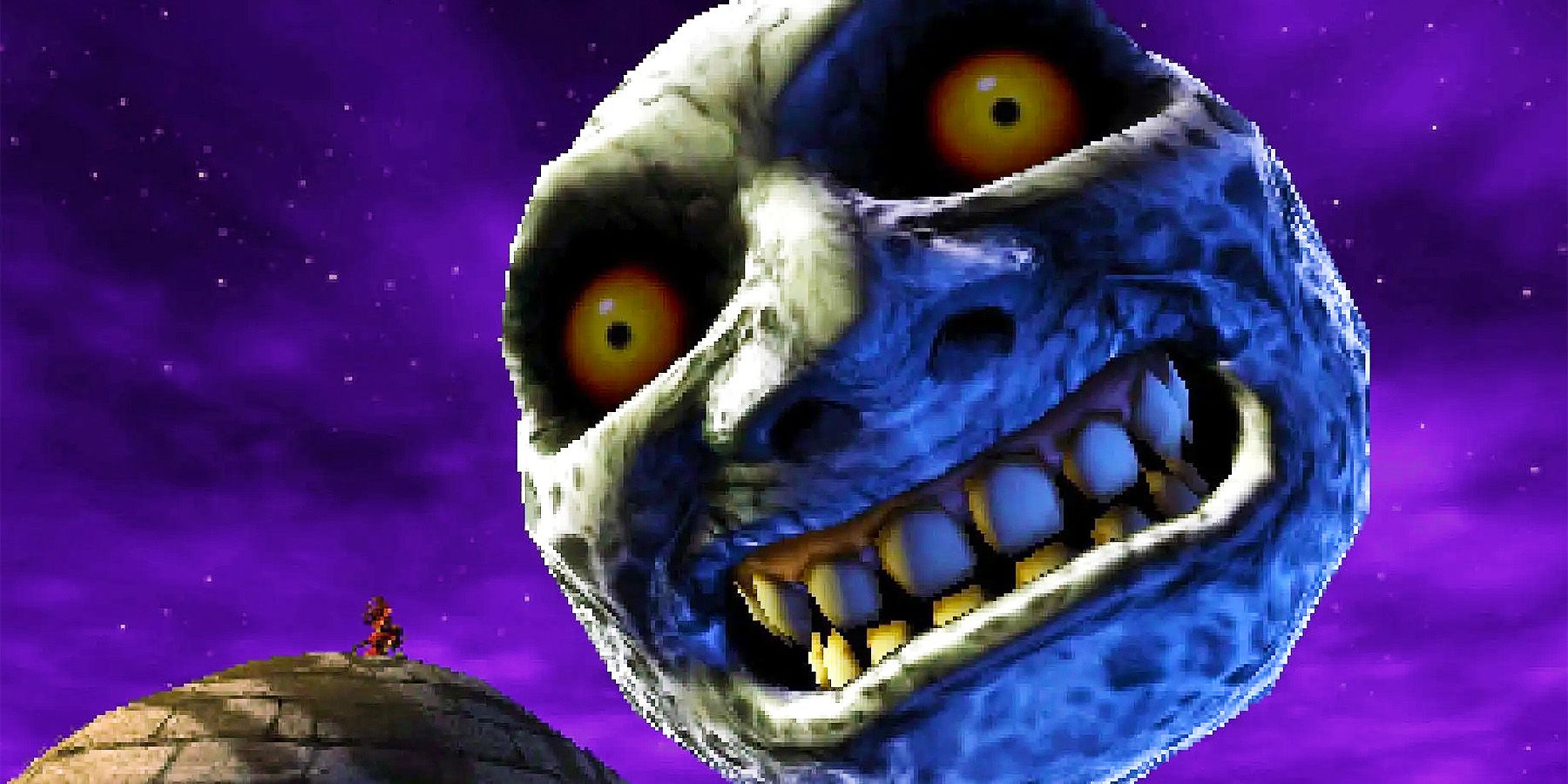
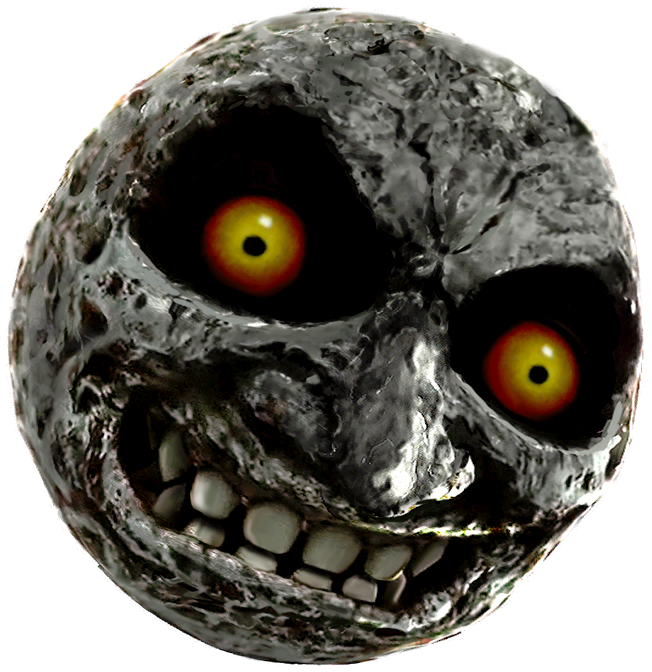
Majora’s Mask, however? We’re talking about a Zelda game that deals with planetary annihilation via a celestial body that’s present in the skybox at all times.
Towns and villages full of people are forced to confront their own mortality and existence as this inevitable timer ticks closer and closer to obliteration. And yeah, sure, Link saves the day by the end and the moon doesn’t kill everyone, but it’s grim stuff for a Zelda game no matter how you look at it.
You know what makes it worse? It’s smiling.
As for the rest of Majora’s Mask, the world of Termina in the game is often considered to be a darker parallel version of Hyrule, and the different regions of this world that Link visits on his quest have their own dark problems that need solving. These include contaminated waters turning people into monsters, a plague that brings the dead back to life and an eternal winter that causes an entire village to nearly starve to death.
All of this is brought about because Skull Kid decided to steal the most evil mask in gaming, which has been brainwashing him ever since he decided to wear it. Majora’s Mask? More like “Major Pain In My Ass Mask”.
Metroid Fusion
You know, when you’re running through the list of Nintendo franchises, you start to wonder how Nintendo ever got this reputation of being a family friendly-only company.
For those more interested in sci-fi flavoured darkness, Nintendo have always had the Metroid series, and like Fire Emblem, you have your pick of the litter when it comes to which game in the series is truly the darkest. Metroid Prime 2: Echoes and Prime 3: Corruption are dark by their very definition. Samus is travelling between the Light and Dark Aether dimensions in 2, fighting a deadly Phazon corruption infecting everything in 3, and clashing with her evil doppelganger Dark Samus across both.
Still, none of that actually compares to perhaps the darkest entry in the series, which is Metroid Fusion. If nothing else, Prime 3 ripped the “Samus is infected/corrupted” storyline from Fusion.
Metroid Fusion opens with Samus essentially getting bodied by a new threat, losing all her powers in the process, a formula that’s about as old as time at this point. Instead of a gun-toting threat though, Fusion’s dubious little creatures are the X parasites, who infect Samus and destroy her central nervous system. The Federation is able to fix her, but peace is short-lived as it’s revealed that the X parasite can replicate the physical appearance of this host. Enter SA-X, a fully powered Samus clone with the most haunting eyes you’ve ever seen in a Nintendo game. She’s also basically invulnerable for 90% of the game, making her this terrifying omnipresent boogeyman that stalks Samus.
Maybe that doesn’t make it the darkest Metroid game, and maybe Metroid Dread is scarier but I could go on about Fusion for eternity.
Eternal Darkness
Yeah, so we’ll be the first to admit that Eternal Darkness: Sanity’s Requiem for the GameCube is to us what lay-offs are to greedy corporate CEOs. We’re obsessed with it, we can’t get enough. Perhaps part of that obsession comes from the psychological need to “want what we can’t have”. You see, with Silicon Knights’ legal issues and subsequent bankruptcy, trying to remake or remaster their old work feels like a tangled web no one would be willing to tackle. Because they’re cowards. Bit of reverse psychology.
Despite that, Eternal Darkness was still published by Nintendo, with it being the first game published by Ninty to earn an M rating from the ESRB. Clearly, Ninty wanted a horror, or just more grown up following on the GameCube, with the Resident Evil 1 remake launching as a GC exclusive. RE4 was also a GC exclusive for about as long as it takes Leon to suplex a Spanish grandma.
But what makes the game so dark, beside the name? While the Kirby series dips its toe into extra-dimensional horror, Eternal Darkness dives wholeheartedly into a Lovecraftian tale across time and space. Stretching across 2000 years, Eternal Darkness tells the story of artifacts connected to godlike beings from another dimension called the Ancients, each looking to use humanity to take over the world and destroy the others. Starting with Alex as she investigates her grandfather’s murder, the young woman stumbles upon the Tome of Eternal Darkness, which details the artifacts as they travel across the world for two millenia.
Spoiler alert: there’s a lot of death, destruction and sanity depletion, which leads to some of the best fourth wall breaks in gaming.
Mother 3
Pretty much everyone knows at this point that the Mother series can get pretty dang dark, but you’d never know that just from looking at video and screenshots. A brightly coloured adventure filled with kids? Seems wholesome enough, until it goes off the rails completely.
Like other Nintendo franchises, nailing down the most dark game is somewhat debated, with some thinking elements of Earthbound like Gigyas’ plan to fill the world full of hatred, or the rescue of Paula at the hands of a child capturing cult, rank high on the dark scale. However, Mother 3’s overall plot, characters and moments are even darker, while still maintaining that brightly coloured veneer of kooky, quirky fun. If you just looked at the characters and stages of Ness and Lucas in the Smash Bros. series, you’d have no idea just how wild Earthbound and specifically Mother 3 get.
Set sometime after the events of Earthbound/Mother 2, Mother 3 takes place on the Nowhere Islands and literally opens with Tazmily Village getting obliterated, main character Lucas’ mum getting murdered and his brother, Claus, disappearing completely. No body is found though, so you just know he’s coming back later.
After some shenanigans, there’s a three year time jump, with players controlling Lucas as he clashes with both the Pigmask Army responsible for the destruction of his village, and a mysterious Masked Man (who definitely is not Claus or Chad Gable), plotting to resurrect a Dark Dragon to trigger a second apocalypse. Yeah, second apocalypse by the way, as the residents of Tazmily village were the survivors of the first one, and the game ends with the dragon being resurrected anyway and the Islands being destroyed. At least the main cast aren’t dead though. Except the Masked Man. He committed suicide at the end. Fun times, all round.
Pandora’s Tower
For those in America, you might be confused by the inclusion of Pandora’s Tower as it was published by Xseed Games instead of Nintendo. However, Pandora’s Tower was the third part of the famous Operation Rainfall campaign that aimed to bring Xenoblade Chronicles, The Last Story and Pandora’s Tower to North America. All three games had releases in Japan and, in some cases, Europe, and were published by Nintendo, but for some reason, Nintendo had no plans of bringing the games to the land of rock, flag and eagle. Cue an organised group of polite and well-meaning gamers, and all of sudden, all three games had a North American release.
This game follows Aeron and his love Elena, as Elena has been afflicted by a terrible curse that’s causing her to slowly turn into a monster. Also, Elena and Aeron are citizens on two separate sides of a war, so there’s a bit of a Romeo & Juliet thing going on as well as the monster transformation. Anyway, Aeron travels to the Thirteen Towers at the behest of Mavda, the Towers’ current guardian, with the hopes of reversing the curse.
In order to actually do that, Aeron has to climb each individual tower, kill the “Master” that’s waiting at the top and hand the flesh of the monster to Elena to halt the progression of the curse. Consuming the flesh of a Master gives Elena insight into the creation of the Towers and the Masters themselves 500 years prior, with each Master designed to be a vessel of the 12 deities of the kingdom of Elyria. It’s the 13th Master, created as an overseer of sorts, where things get really dark, as a husband and wife offer themselves as a raw material sacrifice to create the Master.
However, the wife’s unborn child creates an imbalance that turns the Masters into monsters, and things get absolutely very un-Kirbylike from then on. Love hurts, which sounds a bit like Devil’s Third. SEGUE.
Devil’s Third
Say what you will about Dead Or Alive and Ninja Gaiden’s director and original creative voice Tomonobu Itagaki, but the madman marched to the beat of his own drum. Case in point, Devil’s Third, an ambitious attempt to develop a genre-defying action adventure game for a console that’s considered to be one of the biggest flops of all time. Between the Wii U release and the weak reviews, you’d be forgiven for forgetting that Devil’s Third ever even launched, but it did, and Nintendo even published it. Apparently very begrudgingly.
Despite the poor reviews, Devil’s Third is a pretty dark game when it wants to be, even if the tone and situations shown seem to be played for wacky laughs. The game literally opens with lead character Ivan, a former member of the School of Democracy terrorist group, locked up in Guantanamo Bay yet still given enough freedom to nail a sick drum solo. OK.
Devil’s Third relies on a real-life NASA theory called the Kessler Syndrome, essentially theorising that the destruction of orbiting objects creates debris that destroys more objects, with debris then being created at an exponential rate. In turn, this’d create a debris belt that would make space travel and other missions nearly impossible. Devil’s Third takes this a step further, using the Kessler Syndrome theory to create a world where all the satellites are destroyed because of one terrorist attack and the resulting debris. This sends all of the world’s technology back to the early 20th century, creating a new age of war, famine and suffering.
If that’s not dark enough for you though, SOD also uses chemical weapons and human biological experiments, with Ivan fighting many of the group’s mutants throughout the game. Cheeky sods.
Xenoblade Chronicles 3
Even though the series is developed by Monolith Soft, the Xenoblade Chronicles franchise is Nintendo’s own slice of utterly bleak fiction, but that’s been Monolith’s MO for decades at this point. The Xenosaga trilogy for the PS2 literally used subtitles for each game from the works of Friedrich Nietzsche, so you know that Monolith Soft’s work is going to be a lesson in nihilism in some form or another. Even Xenosaga practically coined the meme of a JRPG party uniting to fight God himself, but Monolith’s more recent work on Xenoblade Chronicles might just be their darkest yet.
For us, Xenoblade Chronicles 3 is probably the darkest one, though that might be because the game kind of frontloads the horrors of the world on the player, only to drop even more devastating revelations as the game goes on.
The game opens with the nations of Keves and Agnus locked in a perpetual conflict, but instead of presidents fighting the war or them even sending the poor, both nations use genetically engineered soldiers with a lifespan of 10 years to fight the war instead. If that’s not bad enough, it turns out it’s all a proxy war created by an organisation known as Moebius, using the life force of the fallen clones to power the entire planet and themselves.
There’s more darkness to be found in Xenoblade Chronicles 3’s story, but we wouldn’t want to spoil everything the game has to offer, especially if you haven’t gotten around to playing the first two games, or even the unrelated Xenoblade Chronicles X. Just know that all four games that bear the name Xenoblade Chronicles name are some of the darkest games you could ever play on the Nintendo Switch, or Switch 2.
READ NEXT: 10 Forgotten & Weird CD-ROM Horror Games
Some of the coverage you find on Cultured Vultures contains affiliate links, which provide us with small commissions based on purchases made from visiting our site.