

If you’re anywhere over the age of eighteen, and you like young adult fiction — particularly fantasy — you get that it’s a complicated feeling. I love the inventiveness and escapism of YA fiction; it often imagines a world where teenagers are granted equal agency as their adult counterparts, which is great.
It also all too often relies on tropes that, if not outright harmful, still make me want to hit my head against something. A girl sacrificing most of her relationships if not her literal supernatural powers for her “true love” when she’s sixteen — small child! No! A boy with an infallible-hero complex who is thirteen but somehow still naturally good at arts that take years to master? Boo. Don’t get me started on the “young heir” trope: these small children know nothing! Where are their parents? Who is letting them rule a country?
Not only are a lot of these arcs just painfully unrealistic to an older audience, but they can imbue expectations of maturity and burden in children that are unfair. This isn’t to say that teenagers aren’t mature — we know from real life they are often makers of change that would make their fictitious counterparts proud — and I don’t want to undermine the sense of agency that these unrealistic tropes can create in teenagers. After all, it’s marketed as YA fiction for a reason: in a period of my life where I often felt powerless, I saw idealised versions of myself with the power and the support systems to actually attain the things they wanted from the world. That’s a really cool gift for a teenager — but, as a twenty-something year old, I often look back on those books for comfort and instead cringe at an author’s complete disregard for just how chaotic teenagers actually are.
However, there are YA authors who tap into the complexities of the teenage experience incredibly well, and this skill makes their books some of the best YA books for adults out there. If you love the world-building and the characters of YA, but would prefer if these tiny children were not expected to act like they have already taken out mortgages and had their mid-life crises, these are for you.
1. The Book Thief by Markus Zusak

The main characters in this popular book-turned-movie are a young girl named Liesel and Death itself, which is cool enough on its own.
Liesel grows up in Nazi Germany and ultimately during the Second World War. The main character’s youth isn’t brushed over or secondary to the story — what makes this novel about the Holocaust so emotionally powerful is in part because Liesel is so young. She experiences the horrors of the Holocaust as she is growing up, finding her place in the world, and trying to maintain a sense of childhood innocence that is rapidly being stolen from her.
It’s a gut-wrenching novel, and Death’s perception of this young girl’s naivety and innocence adds a sense of gravity that enhances the plot rather than detracts from it.
2. The City of Ember by Jeanne DuPrau

Jeanne DuPrau’s City of Ember is a 2003 post-apocalyptic novel that inspired a much less satisfying, if still entertaining, movie. It follows a teenage girl and her friend in what is essentially an underground bunker the size of a city, as they attempt to leave before their entire community runs out of supplies.
There’s the potential plot-wise for everything to start out a little too conveniently — the main protagonist just so happens to be the descendent of one of the mayors of the city to lose the initial instructions for leaving Ember, so she has easy access to them — but DuPrau injects a seriousness and tenderness into the novel to the point where the main character’s triumphs feel nothing but earned.
The friendship between main character Lina and friend Doon does not feel forced or inherently romantic, and their attempt to leave the city feels like it has real stakes because it’s such a novel concept. It also takes the time to point out how messed up it is that humanity’s survival depends on these two children — and leaves their ending equal parts doubtful and hopeful, as well.
3. Cut by Patricia McCormick

This book is technically a quick read, following main character Callie as she attends a treatment facility for self-harm. Callie refuses to speak to the girls she is there with, as well as the therapists and facilitators. This book may not be for everyone — it’s a very hard book to get through — but Callie’s pain and that of the other girls is never minimised nor romanticised.
They act like teenagers, and the narrative doesn’t deny them the right to feel hurt because of their age. Their trials are handled with a lot of heart and humour, and it feels as realistic as it does heart-breaking because it allows us to really see into Callie’s mind without losing the tension of wondering how she got where she did for the majority of the novel. This artful use of silence in such a young character makes this one of the best YA books for adults.
4. The Giver by Lois Lowry

One of the early foundations for YA dystopian fiction, The Giver was popular in English classrooms for a reason. The main character, Jonas, has to come to terms with a society he — and almost everyone else — views as a perfect utopia. He is assigned to learn from the man who holds the society’s past memories of Earth, a world of good and evil and in between rather than the “sameness” their society has opted for instead.
Jonas is a particularly great character for adult readers of YA fiction because his lack of experience or expertise is what makes his training with the Giver so much more viscerally difficult to the reader. How do you explain colour to someone for the first time if they’ve never experienced it, let alone when they’re a child and doing so would rock their carefully developed sense of community?
If your English Lit teacher did not force you to read this, I highly recommend it. If they did, I still recommend reading it again since English courses generally suck at teaching you how to enjoy reading, and despite its tendency to be overanalysed, this book is truly one of the best YA books for adults out there.
5. The Hunger Games by Suzanne Collins

I’m going to keep this brief — because who hasn’t read these books by now? — but you can’t mention the best YA books for adults without pointing out how Suzanne Collins defined modern YA dystopian fiction. Her characters are forced into early adulthood as revolutionaries for a society they never should have had to grow up in, and the full trauma and weight of this responsibility is the crux of all three books. Katniss Everdeen’s mental illness — perpetuated by a government against her through unspeakable acts of violence — is portrayed with painstaking realism.
Reading those books at any age, let alone as a teenager, as I did when they were first released, was incredibly difficult and satisfying. And her ending — one of healing if not happiness — feels earned because we spent time with her trauma over the course of several incredibly well written books. Do yourself a favour and give Katniss the nuance she deserves with a re-read of this genre staple.
6. The Raven Cycle by Maggie Stiefvater

Maggie Stiefvater is one of the most underrated authors I have ever had the fortune to read. Stiefvater’s lyrical and subtle writing style is what really sets this series apart in its genre for an older audience.
Technically, the Raven Cycle is about a boy king and his search for a dead Welsh king with his friends at his side. Really, it’s about magic and loss and mostly about being in love with all of your friends. Very high school. Stiefvater is so skilled at injecting this age-old sadness and connection between her characters and the world around them. You feel what they’re feeling. It never detracts from what is admittedly an epic plot, but again enhances it.
In a world that relies on the theme of very real, very unique magic, Stiefvater makes it feel tangible to her audience with her lyrical style.
7. The Dreamers Trilogy by Maggie Stiefvater

Similarly, The Dreamers Trilogy is a continuation of the story of one main character and a few side characters from Stiefvater’s Raven Cycle. It follows Ronan Lynch, a boy who can bring his dreams to life, and his siblings, in the aftermath of his friends graduating and leaving their hometown. You know, until a lot of people keep trying to kill Ronan.
The Dreamers Trilogy — which so far consists of books Call Down the Hawk and Mister Impossible — may not meet the same high standard for lyricism that Stiefvater set with the Raven Cycle, but she introduces the perspective of a lot of side characters from the first series that help the Dreamers stand on their own. This trilogy is the first time we see the perspective of Ronan’s brothers, including his 21 year old brother Declan who has been their legal executor since their parents died. His long-awaited perspective makes this series hilarious because yes, as we always knew, Ronan is an incredibly powerful magical being. He’s also a complete mess, when it comes to maintaining any of his friendships or feelings of self worth.
We understand why he is this way perfectly, but there is something so satisfying as a twenty-two year old (which, I admit, is still very young) reading Declan’s reaction to his younger brothers’ recklessness and it literally giving him indigestion. Ronan is the heart of this series, but Declan might just be the star, because he provides some much needed sanity to the Lynch family. Just like the audience, all he wants is for his baby brothers to be safe, so if they could stop going on the run from international conspiracies or flinging themselves towards giant bodies of water, that would be great.
8. Sabriel by Garth Nix
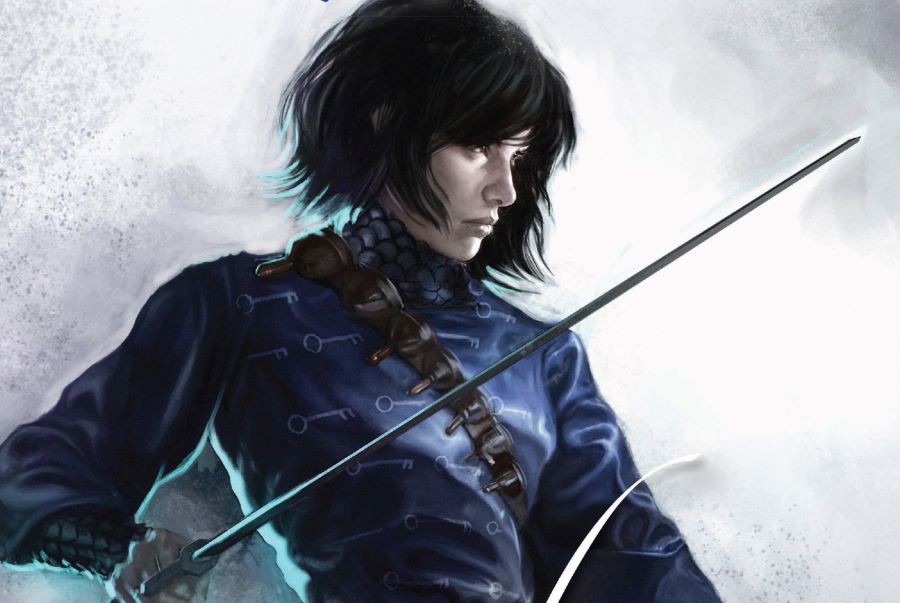
Sabriel is the first novel in the Abhorsen series, which also involves witch-like necromancers and a Chosen One plot line that doesn’t feel particularly unearned.
The main character – Sabriel — is on a quest to find her father, the Abhorsen. It’s an inherited position of incredible power — Abhorsens have the ability to control the dead, ease them into the next life, and stop them from terrorizing the living. But Sabriel has not seen her father in many years, and has not stepped foot in the Abhorsen’s ancestral home in since she was a little girl.
It sounds like the perfect set up for Sabriel’s powers and epic destiny to be hidden from her, Harry Potter style, but Nix makes it clear throughout the book that Sabriel has well and truly earned the quiet competency that carries her through the series into adulthood. She has trained for her future responsibilities from a very early age, and despite the fact that she spent years doing nothing but training in the same magic as her father Sabriel still gets the shit kicked out of her on a regular basis by more experienced or simply brawnier adults over the course of the novel.
Really, the only outlandishly untouchable figure, at least in the beginning, is Sabriel’s father’s house-cat — but I’ll stop there for the sake of spoilers.
9. She Kills Monsters by Qui Nguyen

This one is kind of cheating because it’s technically a play, but She Kills Monsters captures the teenage voice — with all its pettiness, tenderness, capacity for love and capacity for sorrow — as well – if not better – than just about any book I’ve read. It follows Agnes, who is a self-described average young woman in every way. When her decidedly un-average fifteen year old sister Tilly dies in a car crash, she leaves behind a Dungeons and Dragons module that Agnes decides to attempt. In the process she meets Tilly’s friends, discovers things about herself dared to consider, and comes to terms with her sister’s loss.
The characters are often silly, self-absorbed, and defensive — that goes for the adult protagonist as well as her younger sister’s teenage friends. But that’s sort of the point — it doesn’t mean that they don’t feel Tilly’s absence deeply, with a profound sense of love and loss and connection. They extend their grief and their camaraderie to Agnes because they know she feels the same, regardless of the fact that she’s a stranger to them with very little in common. Tilly finds herself through Dungeons & Dragons, and she leaves behind a way for Agnes to find a sense of connection to her sister even after she’s gone.
It’s heart-breaking, sweet, and still managed to make me laugh repeatedly.
10. Six of Crows Duology by Leigh Bardugo

This series has to be one of my favourite subversions of the Chosen One trope. All of the protagonists of this duology are morally grey teenagers. Would they smile at my face while they steal my wallet? Yes. Do I love them and want to wrap them up in a sweater? Also yes.
Leigh Bardugo has a more traditional YA heroine and Chosen One storyline in her first Grishaverse trilogy, Shadow and Bone, but she allows her six protagonists here to be as messy about their past trauma and as gremlin-like in their present as they’d like. Semi-spoilers, but when your only goal is to make some money and you accidentally save your country and an entire community of witches? That’s the definition of turning in an essay last minute and getting an A.
If you enjoy a magical heist, political intrigue, and crying over one of the best female characters of YA fiction, read this book series — and then come gush over Inej Ghafa with me.
READ NEXT: 10 Best Horror Books For Teens
Some of the coverage you find on Cultured Vultures contains affiliate links, which provide us with small commissions based on purchases made from visiting our site.