


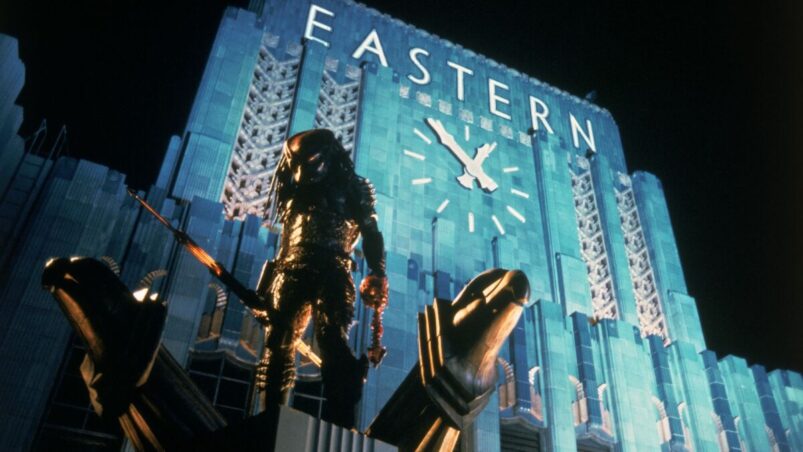
Time to feel old, boys — it’s been 35 years since Predator 2 hit cinemas. To some, this marks three and a half decades since what some consider the “worst” Predator movie was released, but to anyone holding that opinion, you couldn’t be more wrong. Now, I won’t pretend Predator 2 is a classic (it really isn’t) but I assure you, it’s nowhere near as bad as people claim. In fact, I’d go as far as to say Predator 2’s only real sin is that it isn’t Predator.
After the original became a major hit and helped cement good old Arnie as a blockbuster movie star, it shouldn’t be surprising that a sequel was quickly put into production. Writers Jim and John Thomas returned, as did producers Joel Silver and Lawrence Gordon, with Alan Silvestri back to compose the score. The Predator himself, Kevin Peter Hall, also reprised his role as the hulking alien hunter. Two people who didn’t return were star Arnold Schwarzenegger and director John McTiernan. The reason? In short: money.
Both Schwarzenegger and McTiernan moved on to bigger things after Predator, and their salaries would have been considerably higher for a sequel. Arnie had three major movies out in the year following Predator: The Running Man, Red Heat and Twins. McTiernan, meanwhile, was working on The Hunt for Red October, meaning both men were fully occupied and had little incentive to revisit Predator. Instead, it was A Nightmare on Elm Street 5: The Dream Child director Stephen Hopkins who stepped into the role.
Joel Silver then brought in Danny Glover to play Lt. Mike Harrigan. The pair had worked together on Lethal Weapon, and Glover was a reliable hand who excelled at portraying tough, no-nonsense characters in action movies. Harrigan is a totally different character to Dutch — he’s a hardened, experienced cop, an ’80s stereotype who “doesn’t play by the rules”. But what separates Harrigan from Dutch is Glover’s ability to give the character a grounded, everyman quality. He’s tough, yes, but fallible, weary, and simply trying to be the best cop he can. The cast was filled out with a number of character actors, including Bill Paxton, Adam Baldwin and, as the movie’s primary human antagonist, Gary Busey.
Glover is supported by a solid ensemble. Rubén Blades and María Conchita Alonso round out Harrigan’s team. He also has several figures to butt heads with. First, the aforementioned Gary Busey as Peter Keyes, who leads a covert team attempting to capture the Predator. Robert Davi appears as Captain Heinemann — and Davi is always a reliably intense presence, later becoming iconic as a Bond villain in Licence to Kill. And who could forget Morton Downey Jr.? Not a traditional actor but a real-life TV host who pioneered (for better or worse) the era of “shout TV” — a forerunner to the likes of The Jerry Springer Show. He plays Tony Pope, the sleazy host of the in-universe programme Hard-Core.
One casting that thankfully didn’t happen was Steven Seagal. He met with Stephen Hopkins to discuss taking the lead role and was apparently extremely keen, but insisted on playing a “CIA psychiatrist who also had martial arts training”. Hopkins later revealed that Seagal was “clearly a little crazy”, and since he wanted an “average Joe”–type lead, Steven Seagal kicking aliens was swiftly ruled out.
Predator 2 was written in late 1989 over the course of just three weeks and took inspiration from Dark Horse Comics’ Predator: Concrete Jungle series. Instead of trying to rerun the first movie with a few tweaks, the sequel made the smart choice to change the setting entirely, trading the Central American jungle for the chaotic, sweaty, smog-choked urban sprawl of Los Angeles. It instantly gave the sequel a fresh energy and allowed it to stand apart from the original. Photography began in early 1990, and the movie was released in November of the same year — an impressively rapid turnaround for a special-effects-heavy sci-fi movie.
The sequel also added a significant amount of lore to the franchise, which the original only briefly hinted at. Predator 2 introduced several now-iconic weapons, including the combistick, the smart disc and the netgun, as well as expanding on the Predator’s helmet systems. We also get glimpses of the Predator’s electromagnetic and ultraviolet vision modes.
But of course, we need to skip to the end for the most iconic addition to Predator canon: the Alien skull. Yes — the skull of a Xenomorph from the Alien series appears on the wall of the Predator ship. Despite what various unscrupulous YouTube channels may claim, this wasn’t intended to set up a 1990s Alien vs Predator movie — it was simply a fun Easter egg, a subtle nod to Fox’s other major sci-fi franchise.
Other references during the movie’s climax further cement Predator lore. The huge T-rex skull on the wall clearly suggests the Predators have been coming to Earth long before mankind. Some argue it might not be a T-rex at all but an alien skull that resembles one, but the flintlock pistol handed to Harrigan at the end, engraved with “Raphael Adolini – 1715”, makes the point loud and clear. This same pistol is also referenced in 2022’s prequel Prey.
Now, I know what you’re thinking. “Alright, Chubby Checker — if Predator 2 is so amazing, why isn’t it as well-regarded as the original?” First of all, that’s just rude. Second, no — it isn’t as good as the original. Predator is a genuinely brilliant movie. But there is a lot to love about Predator 2. It has a great cast, memorable set-pieces, and solid world-building. It just stumbles in several areas.
The movie is set in a future Los Angeles (the distant future of 1997), where crime is rampant, the police are overwhelmed, and an intense heatwave grips the city. Unfortunately, the setting comes across like an “’80s gang future” — with almost cartoonish caricatures of gangsters roaming the streets. While I personally think this style is fun, it lacks the grounded realism of the original.
Another issue is character build-up. The first Predator spends almost an hour establishing Dutch’s team — their camaraderie, competence, and dynamic. They’re portrayed as an unstoppable force of nature, which is why the Predator dismantling them feels shocking and dangerous. Predator 2 attempts something similar but doesn’t spend nearly as long building Harrigan’s team. And because the characters are designed to embody “ordinary cops in extraordinary circumstances”, they never feel unstoppable.
So it’s no surprise when they’re effortlessly outmatched.
The score is as excellent as ever, and the effects are generally solid, but the direction can sometimes feel basic, giving the movie a slightly budget ’80s vibe. This isn’t entirely Stephen Hopkins’ fault — he was far less experienced than his predecessor. Predator was McTiernan’s third feature; Predator 2 was only Hopkins’ second Hollywood movie. Still, he seemed to have fun with it.
Another drawback compared to the original is the setting. In Predator, the jungle is almost a character in itself. The city is cool, visually speaking, but it doesn’t contribute much to the story in the same meaningful way.
Despite the negatives, Predator 2 remains a solid movie and is well worth revisiting. While it was once considered the weakest entry in the franchise — and effectively killed the series until 2010’s Predators — it’s no longer at the bottom of the pile (thanks, 2018’s The Predator!). Today, it stands as one of the more unique and interesting entries in the franchise. If you’ve not yet seen it, the 35th anniversary is the perfect time to check out this underrated gem.
Some of the coverage you find on Cultured Vultures contains affiliate links, which provide us with small commissions based on purchases made from visiting our site.