


The PS1 had tonnes of breakout franchises. Crash Bandicoot, Tekken, and I’m going to also add Army Men for a change. We did get like 10 of them! Resident Evil though, was one that changed an entire genre forever, and you better believe that other devs wanted a slice of that sandwich pie on the console. Alright, time’s up.
Countdown Vampires
If you wanted to make a legally distinct Resident Evil clone in 1999, changing the zombies into vampires was a good idea to avoid the lawyers.
Long time friend of the channel Countdown Vampires then copied so much else that the comparison becomes impossible to avoid. There are fixed camera angles, familiar controls and inventory management, keys to find, and puzzles standing between you and the next locked door that involve stealing the eyes from a horse or something. Even contemporary previews described the controls and inventory as essentially lifted from Jill and the gang.
The setting is at least its own brand of ridiculous. Keith J. Snyder, fantastic name, is providing security at the opening of a horror-themed casino when black liquid pours from the sprinklers and turns the guests into vampires. Rather than killing every infected person, you can sedate them and use white water to change them back. You can also gamble at the casino’s machines to earn money for supplies. Two pretty cool ideas! And that’s about it.
Critics disagreed about whether those ideas made up for the very bad execution, but few of them were particularly impressed. GameSpot gave it 3.3/10, criticising the confusing camera angles and layout, weak story and flat voice acting.
Others did enjoy the vampire curing and casino setting despite finding the controls and puzzles derivative. It wasn’t universally despised, but it did give Survivor a run for its money. In a bad way.
Its legacy is modest: it’s mainly remembered as a particularly blatant, particularly not great example of the PS1 survival horror rush. The casino and its cure mechanic still give us something to talk about beyond “it’s Resident Evil, but worse”, and also the fact that your guy has his chest out the entire time.
Martian Gothic Unification
The last message from the Vita-1 research base on Mars tells rescuers to “stay alone, stay alive”. Not quite as catchy as “save the cheerleader, save the world” but it does get you going a bit. Naturally, Earth sends three people to investigate this not very chill message. Karne, Kenzo and Matlock enter different parts of the base, where they find an absent crew, locked doors and an increasing number of things that ought to have stayed dead.
Beginning as a point-and-click adventure called Unification and released on PC before reaching the PS1 in 2000, Martian Gothic looks and often plays like Resident Evil: fixed views of prerendered rooms, stiff movement, ammunition to conserve and plenty of backtracking. So far, so few sandwiches short of a buffet.
Its Big IdeaTM is the three-person setup. You can switch characters whenever you like, but they explore separately, speak over the radio and pass useful items through the base’s vacuum tubes, otherwise they might get turned into trimorphs. Finding a key is sometimes only half the job; you then have to work out which poor sod needs it and send it across Mars’s least convenient postal system. It would take Resi a couple of years before it also gave us a similarly terrible system. So you could say Martian Gothic was slightly ahead of the annoying curve.
Reviews were mixed, but the game had its defenders. Official U.S. PlayStation Magazine gave it 7/10, singling out the story, while GameSpot gave the PS1 version 5.9/10. GameSpot liked the three-character setup and the atmosphere of the abandoned base, but felt that passing items through vacuum tubes became tedious and the combat too repetitive.
Martian Gothic has basically been completely forgotten about over the last…26 years. That’s enough horror on its own. Coordinating three isolated characters is a genuinely interesting survival horror idea. Playing it also makes clear why nobody was rushing to bring back the vacuum tubes.
Galerians
Galerians wears its Resident Evil influence openly. Producer Ichiro Sugiyama named Biohazard as one of the games that shaped it, and the result has fixed camera angles, familiar movement, rooms to search and items needed to open the next route. But Rion doesn’t have a gun. He has psychic powers, and using them comes with a fairly unpleasant medical routine.
Rion wakes in a hospital with no memory and a girl’s voice calling to him. As he escapes, he can use his abilities both to attack enemies and to pick up clues from objects. Different chemicals enable different powers, but they’re limited supplies. Push his abilities too far and he starts “shorting”, unleashing a devastating psychic attack while putting his own life at risk. It basically means that our weapon is also part of the problem.
It’s pretty much the greatest Akira game of all time, though the competition is weirdly non-existent?
Contemporary reviews were considerably warmer than those for the first two games in this episode, but a GameRankings score of 68.33% wasn’t quite nice. A lot of the reviews liked how it started and its grimey, industrial atmosphere, but felt it lost a lot the longer it went on.
Galerians: Ash continued Rion’s story on PS2, and a three-part CG animation expanded the setting. Those were both pretty, pretty not good. Developers Polygon Magic would eventually go on to make the rail shooter Silent Hill: The Arcade. Sure. Alright.
Even where its borrowed controls get in the way, Galerians has an identity well beyond being Resident Evil with exploding heads. Although, admittedly, exploding heads help.D-lightful.
Vampire Hunter D
A vampire hunter with a sword, a talking face in his left hand and a castle full of monsters sounds like a reasonable candidate for an action game. The PS1’s Vampire Hunter D, which is somehow both more and less sexy than it sounds, instead sends him through a survival horror game modelled closely on Resident Evil. It follows D’s search for Charlotte, a young woman taken by the vampire Meier Link, drawing on the story also told in Vampire Hunter D: Bloodlust while also briefly letting you play as Leila.
Here, you’ll find polygonal characters against prerendered backgrounds, fixed camera angles, puzzles and plenty of doors to work through. D can do more than a typical Resident Evil protagonist, though. He can jump, guard and strafe, with his sword making combat a bigger part of the experience. Unfortunately, adding those moves to this style of camera creates more problems than trying to get a vampire to come to a garlic festival at 2PM in June. Judging a jump over a pit is difficult, and an angle change in the middle of a fight can leave you trying to work out where D is facing while something hits him.
GameSpot gave it 5.5/10, finding the controls confusing despite liking some of its CG scenes. French outlet Jeuxvideo.com was more generous at 14/20, praising the setting and its ideas while also arguing that the extra moves made the game harder to handle. Neither considered it a match for Resident Evil.
You know what though, it feels rather like a janky Devil May Cry prototype: a stylish swordsman fighting monsters in a gothic castle, only with fixed Resident Evil cameras making every jump and sword fight more awkward than it should be. You can see why somebody thought the combination might work. You can also see D sliding towards another pit.
Evil Dead: Hail to the King
Putting Evil Dead in a Resident Evil-style game sounds like a pretty easy win. Ash is already stuck in a cabin in the woods, surrounded by things that refuse to stay dead. Also released for the Dreamcast, Hail to the King picks up after Army of Darkness and sends him back to that cabin, where his girlfriend is kidnapped and an evil double turns up. Bruce Campbell voices Ash, which gives the game something the other clones on this list can’t claim: grooviness.
Originally called Ashes 2 Ashes before a name change, here you’ll get fixed camera angles, rendered backgrounds, puzzles, backtracking and item boxes. The difference is that Ash has a shotgun and a chainsaw, so the game keeps asking you to fight. Like, a lot. It supplies plenty of ammunition and health, then buries you in Deadites that respawn as you move through an area. The chainsaw can get caught in one enemy while the others pile on, and the camera often makes it difficult to tell whether your attacks are lined up.
It also just has a bizarrely dead atmosphere, with you repeatedly just thwacking floating boys with the same gusto as if you’re buttering a sandwich while depressed.
Reviews at the time gave it a lot of 4s and 5s, criticising the combat, controls and fixed views. That complaint about the camera feels especially funny for an Evil Dead adaptation: Sam Raimi’s films get so much energy from a camera that races around like a Twitter Premium user trying to find their father. Here, it mostly watches Ash struggle from the corner of the room. Thankfully, not in a chair.
There were more Evil Dead games, but the next one, 2003’s A Fistful of Boomstick, moved toward straightforward action and was generally a lot better. Hail to the King remains the one that tried to squeeze Ash into the classic survival horror mould. It has the cabin, the voice and the chainsaw; the trouble is getting that chainsaw to hit anything.
Chaos Break
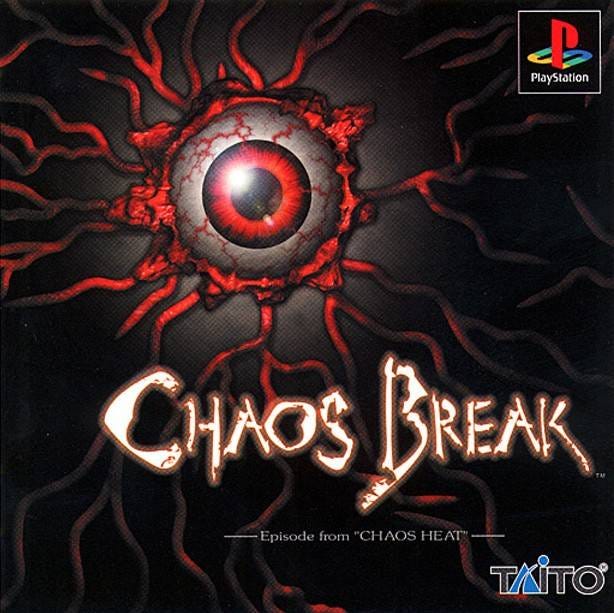
I really do wish this one was a lot better, but that aesthetic and the cover do a lot of heavy lifting.
Chaos Break has a research facility full of escaped creatures, two playable operatives and a trail of computer files explaining what went wrong. Taito could hardly have made the Resident Evil influence clearer. The odd part is that it follows Chaos Heat, a 1998 arcade shooter that was the first game released for Taito’s G-NET arcade hardware, and brings some of that game’s appetite for combat into a PlayStation horror adventure. It was released in Japan and Europe in 2000, it bizarrely never reached North America.
We give you James Corden and you get nothing in return. Sorry guys.
You choose Mitsuki or Rick and investigate a laboratory where alien cells have made a mess of the research. There are locked doors, puzzles and records to read, but Chaos Break basically has you going Rainier Wolfcastle the whole time. Its environments are rendered in real time, and you can move, dodge and attack at a pace closer to an arcade game than the careful stop-and-shoot rhythm of early Resident Evil. You’re searching a familiar sort of doomed facility, then rolling away from a monster and laying into it as if you’re in the average British funeral.
Contemporary reviews were not great, and that seems about right for a game with an interesting bit of arcade DNA, but repetitive lab corridors, boringly easy difficulty and presentation that struggle to make the outbreak particularly frightening. Its connection to Chaos Heat also gives it a small identity beyond being another Resident Evil imitation, but I really think you should try emulation for this one instead of buying. Modern game collecting is a nightmare.
Alone in the Dark: The New Nightmare
There’s a slightly cheeky bit of the master becoming the padawan here. The original Alone in the Dark helped establish the fixed-camera horror formula before Resident Evil existed, one terrible bit of fashion at a time. Why is bro wearing triangles? By 2001, The New Nightmare looked rather like it was following Capcom’s lead but with a bit more of an interest in listening to Creed.
Edward Carnby and archaeologist Aline Cedrac arrive on Shadow Island to investigate a death and end up exploring a mansion full of locked doors, obscure clues and creatures that would rather you didn’t keep pottering about their gaff and bothering their bric a brac. You choose which character to play, with Carnby’s route favouring combat and Aline’s putting more weight on puzzles. Yes, it is like FIFA 95.
The thing that gives it a character of its own is the torch, years before Luigi would suck the gaff up. You can sweep its beam across the dark backgrounds, exposing details and occasionally disturbing creatures that dislike the light. The developers prepared differently lit sections of the backgrounds to create the illusion of a moving beam. On the original PlayStation, that effect is impressive, as is the fact that it came to both PS1 and PS2. Also, Dreamcast. Dreamcast horror next year lads?
The reception was respectable, though hardly unanimous. Eurogamer’s 8/10 was one of the warmer ones, but still nowhere near the praise of its mentee, now mentor. There is also some fun trivia: Stewart Copeland, drummer for The Police and composer of the Spyro games, worked on its music. Not so fun trivia: this is probably the last objectively pretty decent Alone in the Dark game. Everyone just kinda forgot th at reboot immediately right?
Men in Black: The Game
A Men in Black game could have been a pretty basic shooter where every so often you get to neuralise your enemies and they trundle off to get part-time jobs at the local Londis. Instead, the 1998 PlayStation release gives you fixed camera angles, rendered backgrounds, locked doors and the distinct sensation that Agent J has wandered onto the set of Resident Evil with more drip than most of the Stars team. Not all, of course.
The opening follows his recruitment from the film; after that, you can play as J, K or L on separate investigations, including trips to the Arctic and the Amazon. It began on PC in 1997 before The Collective brought it to PlayStation.
There are aliens to shoot and familiar gadgets to use, but a surprising amount of the game involves searching rooms, finding key cards and working out which object you’re supposed to interact with. Well, that’s the idea, anyway. Men in Black’s puzzles are harder to figure out than what exactly made Will Smith get up on that stage.
You also spend quite a bit of time slapping aliens around like they’ve just made very vanilla GI Jane jokes, though sadly it doesn’t make for the greatest night of television. The film’s quick exchanges and effortless cool don’t translate especially well when an agent takes several seconds to turn around and another alien waits politely to be kicked.
Some reviews called it one of the better Resident Evil lookalikes and liked its characters and weapons, while acknowledging its slow response to button presses. It certainly wasn’t universally written off, even if its approach to alien investigation involved rather a lot of wrestling with the controls.
It’s worth looking at today, even with the stiffness and weird lack of basically any music at all.
Overblood
We’ll finish with a game that looks like a Resident Evil clone from a distance, but gets stranger the closer you stand to it. Like a Toucan. A child designed this. right?
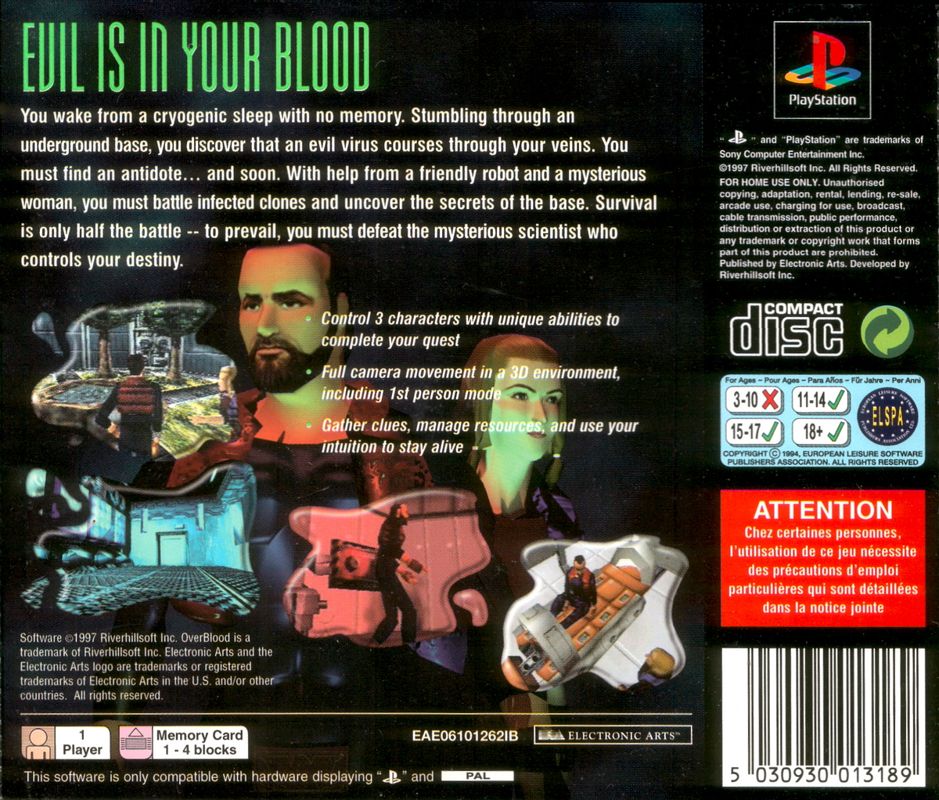
Riverhillsoft released OverBlood in Japan in 1996 as Quentin Tarantino’s new favourite game, with Electronic Arts bringing it to the West in 1997. Raz Karcy wakes from cryogenic sleep in a deserted research facility with no memory, a dangerous infection and very little idea of how to leave. His first pressing problem is more mundane: the room is freezing, and he needs to work out how to survive it.
There are monsters and laboratory secrets, but the early goings feel more like a science-fiction adventure than survival horror. You explore, inspect machinery and solve puzzles, eventually gaining a small robot companion called Pipo, whom you can control separately. The facility is rendered in full 3D, and you can switch between several camera views. That freedom sounds fun until the controls start getting you caught on the furniture. Combat arrives later, though with about as much grace as a reversing dump truck
Reviewers saw the potential and the problems,calling out its awkward movement and frustrating action. IGN scored it 6/10, which is basically a curse of death from IGN. The Resident Evil comparison lines up, as they basically just copied and pasted Barry on Ozempic for the main character. They also knew what they were doing with this tagline. But OverBlood also follows Riverhillsoft’s earlier 3DO horror adventure Doctor Hauzer, which helps explain its interest in 3D exploration and changing viewpoints with a few more horror elements. This is a game trying several ideas at once, occasionally before it has worked out how to make Raz walk around a table.
Akihiro Hino, later the founder of Level-5, says he programmed the first OverBlood by himself before directing its sequel, which swaps the lonely laboratory for a sprawling science-fiction adventure, then slows it down with stiff movement and long, unskippable scenes. It’s a stinker. The first game is worth a glance, but pretty much just that.
READ NEXT: Consoles That Failed (And Didn’t Deserve To)
Some of the coverage you find on Cultured Vultures contains affiliate links, which provide us with small commissions based on purchases made from visiting our site.