


Licensed games often get a bad rap as being nothing more than lazy cash-ins. But these licensed games really took things up a level, even when nobody really asked them to.
Batman & Robin
When people think of ambitious Batman games, they likely go straight to the Arkham series, which isn’t necessarily an incorrect response. The free-flowing combat, the Metroidvania style map design and frankly some of the best comic book characterisations in gaming; all of these combine to make Arkham an ambitious and enjoyable experience for DC fans and newcomers alike. That’s an example of ambition paying off though, and sometimes it’s more fun to talk about ambition that leads to ruin. With that in mind, presenting for your approval, the licensed tie-in to the film Batman & Robin, which tried to tackle the idea of Batman being the world’s greatest detective over a decade before Arkham.
Loosely based on the events of the film, with some additional extra scenarios thrown in for good measures, players can control either Batman, Robin or Batgirl as they’re dropped into a sandbox Gotham City. Instead of just completing levels in a linear order, Batman & Robin takes place over the course of three days and requires players to be in the right place at the right time in order to complete said levels, analysing clues and collecting resources in order to do so. There’s a city to explore, and even unique vehicles for each character, which is undoubtedly ambitious for any PS1 game, let alone one based on a film property. Unfortunately, naff controls and confusing level design made Batman & Robin a bit of a flop.
The Chronicles Of Riddick: Escape From Butcher Bay/Assault On Dark Athena
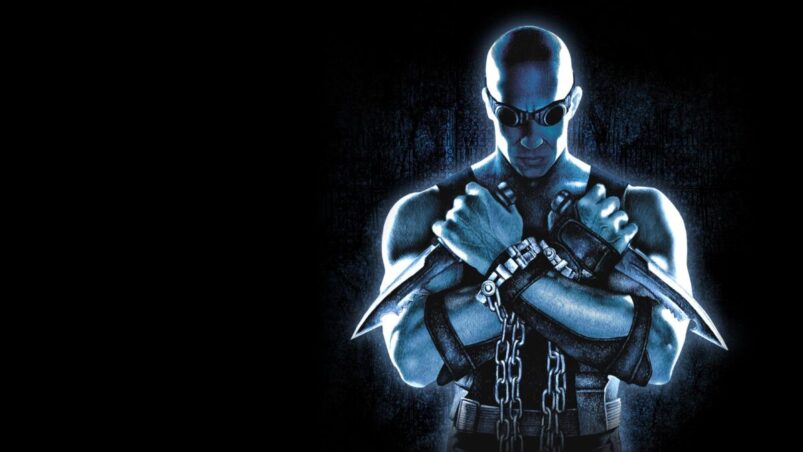
Most people tend to know Vin Diesel as the guy who loves being all about family, drinking Corona and living life a quarter mile at a time, but lean, mean, Vin machine seems to love being in video games. There’s Ark 2, which at this point seems to have a vague release window of “maybe”, while there’s the often-forgotten PS3 and Xbox 360 era open world game The Wheelman. Imagine Driver but less good and you’re about there. Still, Vin Diesel is always going to go down in video game legend thanks to The Chronicles Of Riddick: Escape From Butcher Bay, along with the updated version, Assault On Dark Athena, for the way that they pioneered stealth action games on the sixth and seventh console generation.
A prequel to the events of the original Pitch Black movie, Escape From Butcher Bay is exactly what it sounds like, with Riddick starting the game heading to the titular prison for a lengthy stint. Using Riddick’s special, darkness related powers and heightened abilities, players need to mount an escape, fighting against hostile inmates, overzealous guards and a corrupt warden. If that’s not bad enough for Riddick, the seventh gen port added a new campaign, Assault On Dark Athena, with Riddick having to escape a giant mercenary vessel immediately after the events of Butcher Bay. Dude’s never known a day of rest. Dark Athena might just be a remake of the original game, but the decision to add an extra campaign along with upgraded graphics and improved AI behaviour, just because you couldn’t make the original game backwards compatible on the Xbox 360, is pretty ambitious.
Jurassic Park: Trespasser
We’ve probably mentioned Trespasser more times than it deserves to be mentioned, but as far as ambitious licensed games go, they don’t get more ambitious than this one. It’s also proof that ambition can lead to ruin, considering there’s just simply too much going on here to make the game fun. In a lot of ways, Trespasser feels like the blueprint for a streamer rage game about two decades too early. If it launched now, you’d probably get plenty of viral clips of people struggling to get to grips with the game’s various systems and mechanics. “Trespasser stream when?”, says the humble scriptwriter. Instead, Trespasser was an earnest attempt at revolutionising the first person shooter genre, and it went horribly.
As you’d expect from a Jurassic Park game, you’re dealing with loose dinos as you try to escape from one of InGen’s various dino islands. You can pick up guns and other weapons in order to take on the various dinosaurs crossing your path, but it’s how you use the weapons that makes Trespasser unique. Instead of just holding the gun and shooting at the crosshair, you need to manually control your character’s arm and wrist angle in order to aim your gun. There’s even recoil to factor in, which makes sense but also complicates matters immensely. Again, it sounds like a streamer rage game, but Dreamworks Interactive and EA genuinely wanted to change the landscape of gaming with this. Ambitious effort, terrible execution.
Spider-Man 2
Look, Spider-Man 2 did not need to go as hard as it did when it came to redesigning the web-swinger’s… well, web-swinging. Activision’s previous Spider-Man games were content to lock Spider-Man into tightly controlled levels, with the suspension of disbelief that Peter Parker was just swinging on thin air, and they’d been pretty successful up until that point. Both Spider-Man games for the PS1, then the Spider-Man tie-in game for the first movie on PS2 were pretty big sellers, but the developers at Treyarch weren’t satisfied. Instead of just slapping the events of Spider-Man 2 over the engine of the previous game, they took it upon themselves to completely overhaul the engine, and the results were astronomically good.
Spider-Man 2 finally introduced the wallcrawler to open world gameplay, and along with that came actual physics and momentum based swinging, requiring Spider-Man to use physical objects as anchor points. No more just rubbing the top of his head at the height of the skybox while swinging off clouds, as Spider-Man 2 was the first real attempt at proper swinging in a 3D environment. It was a gamble, as again, the Activision Spider-Man games were already doing well, but the gamble paid off. Spider-Man 2 is still considered by some to be the benchmark of superhero gaming, forever changing what people could expect from their Spider-Man games, and other superheroes too. All of that because the developers dared to be different.
X-Men Origins: Wolverine
Alright, we promise these aren’t all superhero games, but they did account for a majority of the licensed games from the 2000s and early 2010s, so it shouldn’t be surprising to see X-Men Origins: Wolverine as part of this video. Another Activision published banger, and more proof that they need to let some of their dev teams out of the god damn Call of Duty content mines, X-Men Origins: Wolverine does have the unfortunate albatross around its neck that it’s based on that awful movie.
Despite having to work with absolute dreck, Raven Software’s tie-in game feels like a different take entirely. First of all, it’s 18 or M rated, and the blood is flying everywhere during the game. Wolverine’s regeneration is also heavily featured in this game, leading to some incredible gnarly gore and effects that are only really seen in Mortal Kombat games. As for the game’s story, it does follow the events of the film, but spends more time focusing on Wolverine carving through soldiers than him watching some poor farmhands get murdered for no reason. That was a scene that happened in the movie, right? There’s also a prolonged middle section unrelated to the film where Logan just butchers his way through a Sentinel facility, just for fun. It’s probably the best section of the game too. Funny that.
God, that film sucked. At least we’ll always have 2017’s Logan though.
The Lord Of The Rings: The Third Age
EA could’ve absolutely just rested on their laurels and farted out a few licensed tie-in games that directly follow the events of the films, and they did. The Two Towers is alright, though everyone kind of agrees that Return Of The King’s tie-in game is stellar stuff. That’d probably be enough for most publishers, but EA decided to go that extra step, and for once, it wasn’t the worst decision ever made. Developed by EA Redwood Shores, The Lord Of The Rings: The Third Age is more than just a mere retelling of the events of the movies, instead giving players a whole new adventure with a brand new “fellowship”, all interwoven with the adventures of Gandalf, Frodo and the rest of the gang.
The Third Age starts with the new Fellowship, including human Derethor, elf Idrial, Dunedain ranger Elegost and dwarf Hadhod, banding together under a common goal of supporting the old school Fellowship. They follow them through the Mines of Moria, they stand with Gandalf to hold back the Balrog, they’re integral to the battle of Helm’s Deep and they even distract the Eye of Sauron during the climactic final battle so the rest of the actual heroes can do what they need to do. The gameplay itself is basically what you’d expect from a Final Fantasy game at the time, but again, considering EA were already making bank selling unoriginal LOTR tie-ins, The Third Age felt like a super ambitious victory lap.
Toy Story 3
Typically, licensed video games of kids movies tend to be a bit crap. Turn the events of the film into a bog standard 3D platformer, bish bash bosh, profit off mums buying the game for their kids for Christmas. The Toy Story franchise isn’t exactly immune to this phenomenon, with Toy Story 2: Buzz Lightyear to the Rescue following the platformer collectathon blueprint to a t. Half of follow-up Toy Story 3 follows the same formula too, with the Story mode of the game retreading the steps that Andy’s toys take throughout the movie. You know, just with a little bit more platforming and a little less existential dread as you watch movie characters you grew up with face their own mortality at the mercy of an industrial incinerator.
Bleak film finale aside, Toy Story 3 gets the ambitious nod for the second half of the game, Toy Box Mode. While other Toy Story games were about the characters themselves, Toy Box Mode was all about the feeling of playing with toys as a kid, not unlike the awesome intro scene to the film. Players are given a western town sandbox that they’re free to customise and develop as they see fit, completing missions in the process to unlock more and more toys to play with. The Toy Box Mode could have just been a blank 10×10 square that players could drop items into and call it a day, but it feels like its own game with its own rewards and progression separate from the main story experience. Sure, it’s no GTA 5, but it’s a fun and ambitious addition to a game that didn’t really need it.
Die Hard Trilogy
We’ve spoken about the Die Hard Trilogy game before, but it’s been a while since then and quite frankly, it’s hard to mention ambitious licensed games and not think of the bonkers three-in-one extravaganza that is the Die Hard Trilogy. Why buy just one game, when you can buy one game that’s actually three games? Hard to refuse a proposal like that, though we’ll be the first to admit that not all the game genres depicted are as deep as each other. Still, the idea of developing three separate styles of game to match the three different original Die Hard movies is nothing short of ambitious, but where Probe Entertainment arguably deserves the most credit is how each genre matched the action and tone of the films.
The first film takes the form of a third person shooter, with players controlling John McClane as he sweeps Nakatomi Plaza floor by floor for terrorists and hostages. Die Hard 2 plays out like a light-gun game, with John shooting his way through several shooting galleries across Dulles Airport, blasting terrorists along the way. Finally, Die Hard With A Vengeance follows McClane’s attempts to stay one step ahead of Simon Says, racing around New York trying to defuse bombs. Each one is completely different to the others, yet pulls from their respective movies in smart and enjoyable ways, and they’re all incredibly fun. The game was even successful enough to warrant a sequel, Viva Las Vegas, which used all three gameplay styles to tell a brand new story.
South Park: The Stick Of Truth
South Park is no stranger to video game adaptations, and let’s be honest, a lot of them have been a bit crap. There’s been some good ones, like the N64 FPS game, but then you get the utter crap like South Park Rally or the more recent Snow Day game. For 2014’s South Park: The Stick Of Truth, both Obsidian and the South Park team as a whole decided to lock the fuck in. Considering the actual South Park TV show during its seventeenth season dedicated a multi-episode arc in the lead up to the game’s release that set the “fantasy LARPing” premise into motion, you could tell that the show’s creators and writers were putting their faith into The Stick Of Truth more than any of their other games. They also made sure to fire a few shots about how long the game took to develop, but that wasn’t entirely Obsidian’s fault. Points to THQ, the original publisher, shutting down.
Following on from the three part event in season seventeen, The Stick Of Truth sees the young lads of South Park engaged in their fantasy experience that definitely isn’t inspired by Game Of Thrones. You play as a New Kid, lovingly referred to by everyone as Douchebag, as you join the game only to find yourself caught up in alien abductions, government conspiracies and more Nazi zombies than you’d find during round 30 of Der Riese. The gameplay takes its cues from other RPGs like Earthbound and Paper Mario, so it’s hard to call South Park: The Stick Of Truth original, but the spirit of South Park is undeniable, and Obsidian do their utmost to ensure the gameplay is up to the same standards as the humor. Also, The Fractured But Whole is a decent sequel too. Just throwing that mention in there before someone in the comments does.
Alien Resurrection
You’re probably already intimately familiar with the story of Alien: Resurrection’s twin-analogue control scheme. Over a year before Halo, this movie tie-in game helped to normalise the idea of “left stick equals movement, right stick equals aiming”, and all the thanks that Alien Resurrection got for it was a scathing review from Gamespot. “The game’s control setup is its most terrifying element.” Jeez Gamespot, that’s a worse burn than the one Ripley took at the end of Alien 3, and it’s aged about as well as a politician’s promise considering it’s become the standard control scheme for shooters on console. Being ahead of the curve is an ambition all its own.
The control sticks are definitely part of why Alien Resurrection is ambitious, even if the rest of the game is a fairly rote action-horror shooter. What makes Alien Resurrection so ambitious and impressive is the fact that it even launched in the first place. Developed by Argonaut Games, the guys behind Croc: Legend Of The Gubbos and who’ve recently reformed in the past year, Alien Resurrection was announced in 1996 to launch in time with the movie’s release in ‘97. Development would undergo two separate genre pivots, going from a top-down shooter to a Tomb Raider-like 3D action adventure, before finally settling on an FPS. Senior designer Christopher Smith even stated that if the game stayed as a third person game, it would have been cancelled, so the fact that Argonaut managed to stick with the game’s development despite lost work and low morale is astonishingly ambitious.
READ NEXT: 40+ Ultimate PS2 Hidden Gems
Some of the coverage you find on Cultured Vultures contains affiliate links, which provide us with small commissions based on purchases made from visiting our site.