


Consoles, I love them. No matter what they are, big or small, I love a bit of ol’ tech in my gaming collection. There are many awful consoles that totally deserved their downfall, such as the Amstrad GX4000, the Tiger R-Zone or the infamous Ouya. But not all consoles deserve this fate. There are many consoles that were released over the course of history that had a ton of potential and were fairly epic, but still managed to fall face first into the sandpit. These are the consoles that failed, and didn’t deserve to.
3DO Interactive Multiplayer
The 3DO was genuinely one of the most powerful consoles ever made when it was released in 1993. Its CD based technology aimed to bring the age of the CD-ROM into the home, something that had previously only been available to the PC master race. It aimed to bring full motion video to consoles, a technology which at the time was viewed as the future of gaming, but also brought a slew of enhancements over the 16-bit rivals available at the time. The 32-bit console offered hardware scaling, texture mapping and high resolution that (at least for the time) was revolutionary and aimed to be a full multimedia centre offering support for music and video CDs as well as interactive software. Oh, and video games.
The 3DO had one major stumbling point: that price. $699 when it was released in the USA in 1993 is the equivalent to $1,500 when adjusted for inflation. At the time it was a ludicrously expensive piece of tech, and frankly it priced itself out of the market, especially when the Sony Playstation launched for $299 only a year or so later.
Atari Lynx
What if I told you that only months after Nintendo’s Game Boy was released in 1989, a more advanced handheld console also came out. Whereas the Game Boy only had a monochrome screen with no back light, the Atari Lynx boasted a full colour, backlit LCD screen, and also hardware scrolling, which allowed for rudimentary 3D graphics…on a mother-flippin’ handheld in the 80s!
The console layout was particularly interesting, as the entire coldsole could be flipped upside down for left handed people to play comfortably. It also had the ability to link to other Lynx’s using the comlynx cable, allowing for multiplayer handheld gaming almost four decades ago.
But as it happens, superior tech simply wasn’t enough in front of the juggernaut that was the big N. Nintendo was coming off a smash hit with the NES in the mid-80s and had built massive brands with the likes of the Mario Bros. Atari couldn’t compete with Nintendo, as the Game Boy had heavy first and third party support with the likes of smash hit Tetris gracing the console. Also, the Lynx ate batteries like there’s no tomorrow, taking 6 AAs, whereas the less powerful Game Boy took only four batteries, and had a much longer battery life.
TurboGrafx-16
The TurboGrafx-16 was released in 1989 as a competitor to the likes of Sega Genesis/Mega Drive and SNES. A western release for NEC’s PC Engine console, it actually had an advanced graphics chipset which easily rivaled other 16-bit consoles on sale at the time by offering close to arcade quality graphics. The TurboGrafx-16 had a fantastic game library with many arcade ports, and featured the likes of Soldier Blade, R-Type and Bonk’s Adventure. It is also the first home console to offer a CD-add on, releasing in 1990. It gave gamers access to fully animated cutscenes, CD-quality sound and extensive voice acting. It was the closest many people got to CD-rom technology at home, and in Japan the PC Engine became a huge hit.
While the PC Engine was a massive success in Japan, it tanked in the west. Frankly, it was purely down to the lack of marketing for the console. It was incredibly rare to see one “in the wild.” I certainly do not recall it being spoken about in the video game magazines of the era. I also never saw one in stores, with the Mega Drive vs SNES rivalry dominating shelf space. Much of the huge Japanese library simply never made it to the west, and the CD-Rom format was probably a little too early for everyone.
Sega Saturn
In the early 90s, the excitement was palpable for the future of gaming. Consoles were becoming more powerful year by year as the competitive market strived to push things forward. Sega had major success with the Mega Drive/Genesis and had dipped their toe into the next gen waters with CD and 32-bit Mega Drive add-ons, the Mega CD and the 32x. But the Saturn was the first 32-bit console from one of the major players and it did some things exceptionally well. The Saturn had unparalleled 2D performance, some amazing next-gen fighting games such as Virtua Fighter and Fighting Vipers, as well as some near perfect arcade conversions of Sega titles. It should have been a smash hit.
However, the aforementioned add-ons had previously damaged Sega’s reputation amongst gamers. While they were undoubtedly impressive, the Mega CD became known for naff FMV shovelware and the 32x came out pointlessly late in 1994, not long before the Saturn’s launch.
The American launch of the Saturn was also shadowdropped, meaning that many retailers simply weren’t ready for them, and the console had a high cost at $399. The Playstation which was due out in a few months and costs $100 less, had better marketing, and was heavily pushing 3D polygonal graphics, which looked truly next gen and made the Saturn’s blend of 3D and 2D look a little off the pace. All these mixed with the complex architecture of the Saturn meant that the Saturn felt like a bit of a wet sandwich following the Mega Drive.
Neo Geo AES
Growing up, there was one console I wanted more than any other: the Neo Geo AES. Arcade quality graphics, huge sprites, strong sound and music — it blew away anything else on the market. Mixing that with its almost mythical nature (I only ever saw it on TV and in gaming magazine adverts) meant that I desperately wanted one and could never have one.
Whereas the Mega Drive and SNES offered at least graphically inferior arcade ports, the Neo Geo gave you the very same arcade experience in your home. Arcade classics such as Fatal Fury, The King of Fighters, Windjammers and Metal Slug all appeared on the console, and feature large arcade style controllers with joy sticks. While it wasn’t really for the mainstream, it did appeal to arcade fanatics and those who wanted a more polished gaming experience in the home.
But the Neo Geo’s greatest stretch was also its greatest weakness. It was a luxury console, and launched at around $649 in 1990 — that would be the equivalent of $1650 today! And that wasn’t the only eye watering cost about the console. The cartridges, which were essentially arcade boards in a plastic casing, also cost a bomb, with individual games setting you back between $199 and $299. While this console was being marketed as a luxury device for enthusiasts, despite its high quality, it was destined to become a niche device that never gained a foothold in the console gaming market of the 90s.
Nintendo Wii U
It’s easy to clown on Nintendo’s worst selling home console, selling only 13 million compared to the Wii’s 101 million – making it a somewhat embarrassing follow up. But it’s not a bad console in itself, and this next fact is one that doesn’t really get mentioned at all. The Wii U is a Nintendo DS home console. Think about it: big top screen for viewing, smaller lower screen for interacting? It makes sense; the DS is Nintendo’s biggest selling dedicated handheld console, no wonder they looked to it for inspiration for their next console.
The Wii U featured an innovative GamePad which allowed for off screen gaming, as well as added interesting additions to various games. For instance: handling your inventory in ZombiU didn’t pause the game, and added tension as you had to look away from your TV to find what you needed.
So why did the home-bound DS not work? Firstly, from my personal experience, people didn’t know what it was. Working in a gaming department at a retail shop, the more casual gamers the Wii had brought to the table didn’t always realise that the Wii U was a follow up. The Wii had several peripherals, even the confusingly named Wii uDraw tablet, and some folk thought that this was just a new add on for the Wii. While it was a decent console, it lacked classic games. New Super Mario Bros U, Super Mario 3D World, Captain Toad and The Wonderful 101 are all solid, but there were few mainline sequels for major Nintendo franchises upon release.
The Wii U had some great ideas, but it landed at the wrong time and poor marketing didn’t help its cause.
PlayStation Vita
The PlayStation Vita is one of the very best handhelds ever released. The right dev could produce visuals approaching the PS3, and its 2011 OLED screen felt premium, offering a visual experience not seen on handhelds elsewhere. Front and rear touch controllers, dual analogue sticks as well as motion sensors made the Vita the most advanced handheld console on the market. It was bolstered by a strong first party line up, with the likes of Uncharted: Golden Abyss, WipEout 2048, and Gravity Rush really showing off what the console could do. It also featured a great indie line up with the likes of Fez, Shovel Knight and Hotline Miami all making their way to Vita. Remote play even allowed compatible PS4 games to be streamed on the Vita, a feature years ahead of its time.
However, it wasn’t all good stuff. Many were critical of Sony’s decision to ensure the Vita needed proprietary memory cards which could be very expensive; a 64GB card costing as much as $120. While the initial line up of games was solid, Sony’s interest in the console wavered pretty sharpish, shifting more focus on the PS4, and Vita releases became few and far between, relying more on ports and indies for its library.
It was woefully outsold by its main rival the Nintendo 3DS, which had shifted an impressive 76 million units, greatly eclipsing the Vita’s 16 million copies. It was also massively outsold by its predecessor, with the PlayStation Portable selling 80 million copies itself. The Vita went from meaning life to forgetting the meaning of life pretty quickly, and that’s a shame.
Nintendo GameCube
Now I can already hear you shouting: “the GameCube was awesome and not at all a failure, you’re an idiot and I hate you.” You are not wrong. The GameCube was actually one of Nintendo’s finest consoles and their most powerful to date. Powered by an impressive IBM processor and ATI graphics chip, it often outperformed the PS2 in regards to ports, and Nintendo’s trademark quality of its first part titles were unparalleled. Super Smash Bros Melee, Metroid Prime, Super Mario Sunshine and Resident Evil 4 all made their debut on the console and are still today considered amongst the best in their genre. The controller was also iconic; comfortable, durable and featured one of the best analog sticks of its generation.
But Nintendo was already facing off against a perfect storm of completion woes. The PlayStation had totally changed the game and in an instant Sony became the no.1 in console gaming. Weird marketing and a cooler, more ‘mature’ feel to the brand made the PlayStation 2 feel like a big deal. Microsoft also bet big on the Xbox, and the new kid on the block was everywhere – which effectively pushed the former no.1 gaming company into third place and saw many people pass over the GameCube.
The GameCube couldn’t shake off Nintendo’s family friendly feel, despite attempting to appeal to older gamers with exclusives Resident Evil 4 and Eternal Darkness, with huge gaps between releases at some points. Also, it didn’t help that Nintendo decided to go for a ‘miniDVD disc’ format which could hold less than half the data of standard DVDs that the Xbox and PS2 used. No watching The Matrix, no party.
Sega Dreamcast
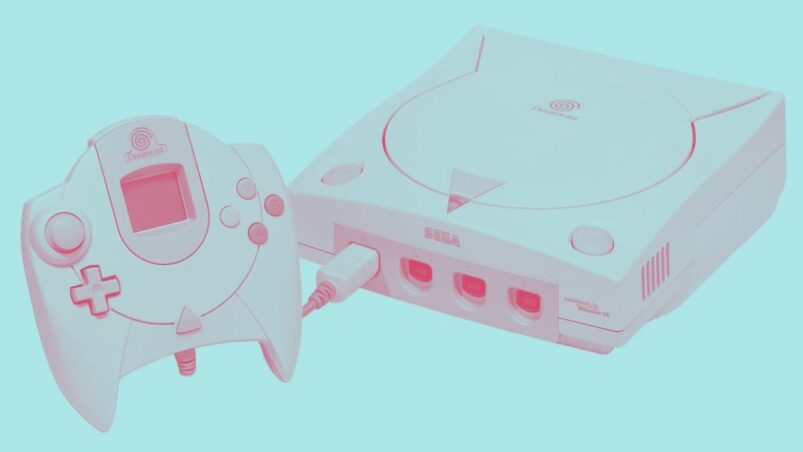
When the Dreamcast launched in 1998 it really felt like the future. The sleek white box with the rounded curves of the buttons and disc tray was peak Gen X Soft Club aesthetic.
With powerful graphics and processor, it greatly outshone the aging PlayStation. Games were full of colour and ran at a buttery 60 frames per second, and once again Sega leaned heavily on its arcade credentials with perfect conversions of many of its coin-op titles. It also truly embraced the coming of online gaming, and every console included a modem as standard, allowing for online play in classics such as Phantasy Star Online, Quake III Arena and ChuChu Rocket! It even featured some late Sega classics such as Jet Set Radio, Power Stone, Shenmue and Sonic Adventure. Sega’s memory cards were inspired too. The Visual Memory Unit featured its own screen and controls, functioning as a miniature handheld gaming device.
But despite being a late 90s gaming juggernaut, it was a bit too late for the company that created the blue blur. Sega had damaged consumer confidence following the Mega Drive, the expensive Mega-CD was disappointing, the 32X was pointless and short-lived – and while the Saturn was an improvement, it lagged far behind the PlayStation. The PlayStation hadn’t just been another gaming console, it actually transformed the industry. Gaming was often considered as merely a childish pastime and games and consoles were often bundled in with toys in the retail catalogues. Suddenly, the PlayStation was grown up, seemingly suitable for adults and above all else, ruddy cool. Stump up for a Dreamcast or wait for the upcoming sequel to the coolest console ever? No brainer for many.
The Dreamcast had strong early sales but they slowed fast. The console was discontinued in 2001 and Sega exited the console game entirely. Its legacy lives on however, as in recent years it has become the focus for fan-ports and homebrew gaming – so despite being a failure, in some ways, the dream still lives on.
READ NEXT: The First Failed Video Game Universe
Some of the coverage you find on Cultured Vultures contains affiliate links, which provide us with small commissions based on purchases made from visiting our site.